*|MC:SUBJECT|* *|MC_PREVIEW_TEXT|*
Ia Ora Na
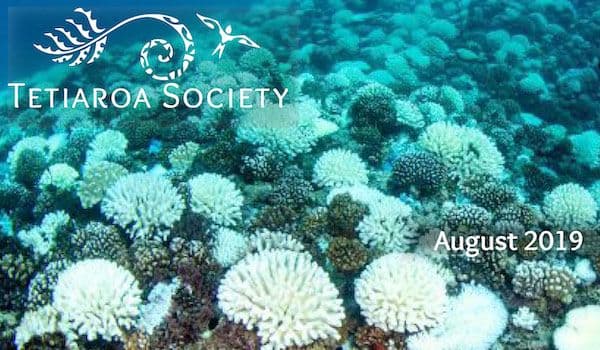
Welcome back to Tetiaroa, where the humpback whales are making babies, and life on the reef rolls on. But this year there was an uncharacteristic warming and bleaching event in French Polynesia – uncharacteristic since it was not in an El Nino year. Normally warm summer temperatures early in the year spiked to 31°C and stayed that way into April. Scientists recorded severe bleaching in Moorea, where the majority of corals at 3-20 meters on the outer slope of the barrier reef died from bleaching. The corals in the lagoon and in shallow depths apparently were more resistant to the rise in temperature and did not bleach. On Tetiaroa, we saw the same pattern, but with only around 50% of the coral dying at depth.
It is too soon to say what this event means for the future of the reef, but in the short-term we are hoping that the progeny of the corals that survived this event will take over to produce a community that may be more resistant to warming in the future. We have been hosting scientists at our research station on Tetiaroa who are researching and attempting to find solutions to the threat to marine ecosystems caused by bleaching events such as this. But to help solve this problem we also need more urgent action on a global scale to combat global warming.
The Indispensable Zooxanthellae
Do you know that there is a little-known organism that plays a huge role on coral reefs? The common name, Zooxanthellae, actually represents a group of single-celled algae that are symbiotic with corals and other reef organisms. These tiny photosynthetic organisms are present in the ocean as plankton before they enter the cells lining the “gut” of corals (gastrodermal cells). Once there they provide sugars, glycerol, and amino acids to the coral and in return the coral provides carbon dioxide, phosphates, and nitrogen compounds to the zooxanthellae. Because the outer fleshy layers of a coral’s body (including tentacles) are actually transparent, the colorful layer of zooxanthellae in the gut cavity can be seen, essentially providing the coloration of the coral colony that we see when exploring a reef.
More about these tiny creatures
The Whales are Back
It is Humpback Whale Season again in Tetiaroa and Tetiaroa Society staff were lucky to get some time in the water with a mother and calf and "escort" male. The mother and calf were moving very slowly, just changing position by 100 yards at a time to stop for the calf to feed. The calf breathes more than the mother so you see it coming to the surface on its own. You can also see it nursing from teats low on the mothers ventral side. The male with them generally stayed separate but you see it surface one time in a very strange way, with its dorsal fin up and head down. Not sure what is going on there.
Meet Tapu Tetiaroa Society's newest ranger.
Tetiaroa Society's winning t-shirt is for sale!
Remember a few months back when we asked which t-shirt we should make? Your votes are in and you can now purchase a Tetiaroa Society t-shirt in the winning 'Earth' design!
All proceeds go directly to Tetiaroa Society to protect and preserve what makes Tetiaroa Atoll one of the most pristine and innovative living laboratories on Earth.
Support Tetiaroa Society today with the purchase of a t-shirt!
A Dreamliner named Tetiaroa
ATN news Tetiaroa Society partner Air Tahiti Nui inaugurated their newest Boeing Dreamliner, which has been named "Tetiaroa". This is a wonderful recognition of the importance of Tetiaroa to the territory, and in addition Tumi Brando was asked to be the "Godmother" of the plane in recognition of her family's role in the history of the island. Philippe Schyle, Mayor of Arue, and Tetiaroa Society Board member, was named "Godfather" of the plane. These new planes are much more fuel-efficient than the older Airbus which they replaced.
Donations in action!
Tetiaroa Society receives generous support from The Brando for our core operations, but our ability to carry out innovative programs depends on your help -- any amount is appreciated!
Tetiaroa Society is a US registered 501(c)(3) nonprofit organization (Tax ID #45-1080688). We host scientific research, develop and implement conservation and education programs, and curate the island's knowledge base. We partner with The Brando to establish Tetiaroa as a model for sustainability, where businesses, non-profits, scientists, educators and the local community work together for common goals. Our program objectives are summarized in our Conservation and Sustainable Use Plan, which is available on our website.
© 2019 Tetiaroa Society