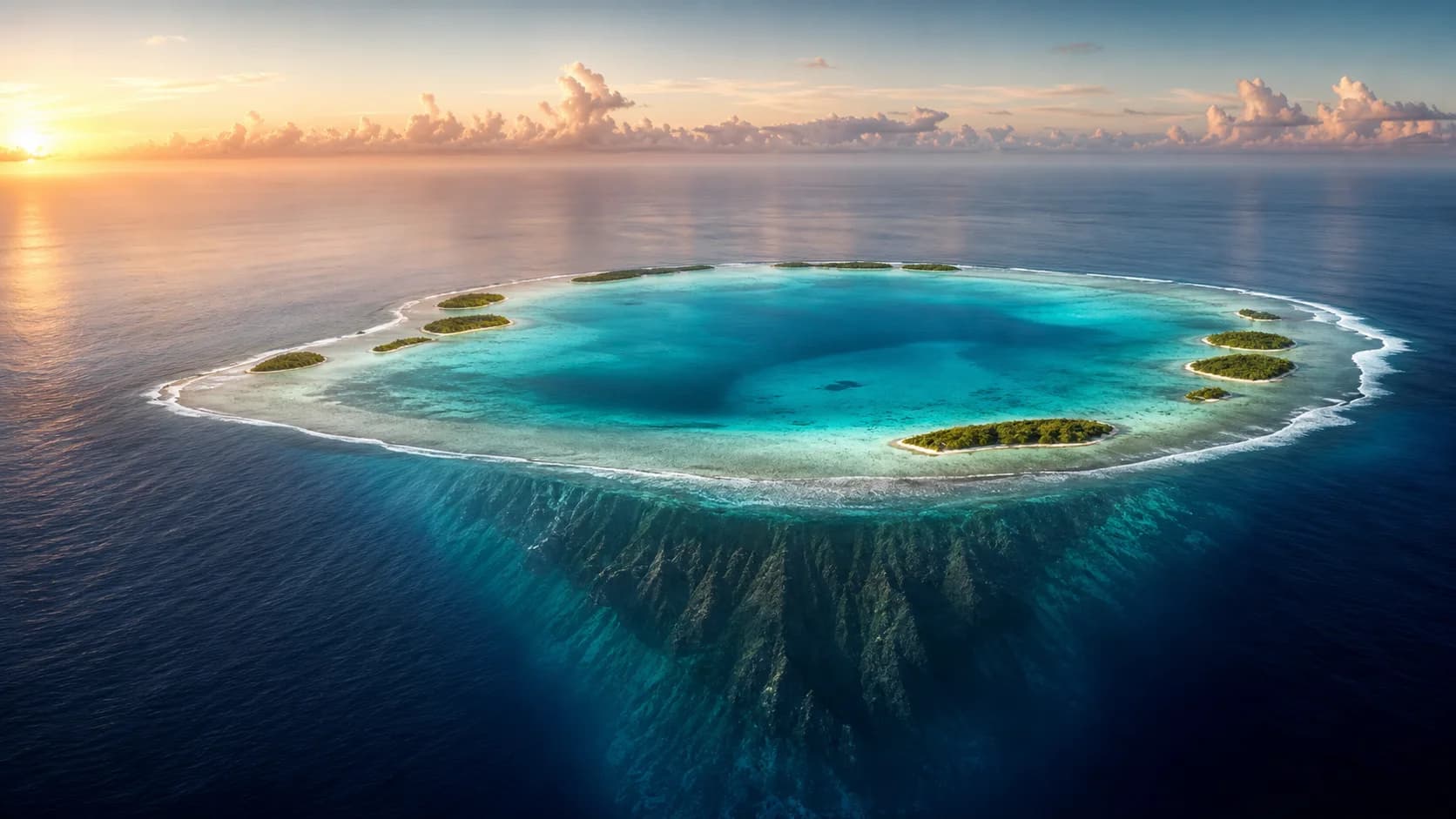
0 metresWarm mixed layer
The lagoon
Twenty-eight degrees. Perfect for swimming, but not for cooling. We need to dive deeper.
Tetiaroa · Sea water air conditioning
Cooling requires you to move heat from one place to another. In the tropics, that usually requires an immense amount of energy... until you look down. Nine hundred metres under Teti'aroa, the Pacific sits at five degrees.
The descent
Follow the pipe all the way down to where the water sits near freezing.
Twenty-eight degrees. Perfect for swimming, but not for cooling. We need to dive deeper.
As we descend down the reef wall, the sealife changes and becomes less frequent. The water begins to cool and the amount of light starts to decrease.
A hundred-thousandth of the sunlight that hit the surface. Divers call this the twilight zone. The water is cooling now, and the pipe still has seven hundred metres to fall.
The ocean's dividing line. Above it, sun-warmed water that mixes with the surface. Below it, a different ocean entirely.
Every day, every season, the water here sits near 5 degrees. Now that we have reached it, this ice cold water can be pumped to the surface.
The cold seawater flows across a heat exchanger, absorbing the heat from anything from air conditioning to server cooling, and then pumps the heated water back into the warm, upper layers of the ocean.
A cross-section of the water column beside Tetiaroa, from the reef at the surface down to the intake pipe mouth at 900 metres, with temperature falling from 28 to 5 degrees.
The basics
Sea water air conditioning replaces the part of an air conditioner that makes cold. Instead of a compressor burning electricity to chill water, a pipe runs out to where the ocean is already cold and brings that cold ashore. The seawater never enters a building and never mixes with anything. It passes a titanium plate, hands over its chill, and goes home. Everything downstream is ordinary air conditioning.
From a cold water source, pump the water to the heat exchanger
The seawater passes thru a heat exchanger. It sucks the heat out of a fresh water loop. The two loops never make physical contact.
Chilled fresh water circulates thru a closed loop cooling rooms, systems, servers, etc.
The warmed seawater is returned to the warm upper layers of its source
The meter
Same building, same rooms, same afternoon, same number on the thermostat. One runs a conventional chiller. One runs sea water air conditioning. Give the meters a moment, or skip to the end of the year.
Conventional chiller: 833 kW. Sea water air conditioning: 125 kW.
| Cooling load | Conventional chiller | Sea water air conditioning |
|---|---|---|
| One villa | 22,500 | 3,375 |
| Small hotel | 1,050,000 | 157,500 |
| The resort | 3,750,000 | 562,500 |
| A hospital | 7,500,000 | 1,125,000 |
These figures come from a model, not site meters. It assumes a seasonal COP of 3.0 for a conventional chiller and a whole-system COP of 20 for SWAC, including pumping and distribution, over 4,500 equivalent full-load hours a year. Diesel is used only as a comparison: one litre represents 3.6 kWh of delivered electricity and, if burned, 2.68 kg of CO₂.
Elsewhere
Plants that are running, freshwater cousins, and a few that never got built. Drag the globe. The pattern is easy to spot: this technology follows steep coastlines and deep lakes, and thins out where the shelf runs long.
Drag to rotate · tap a marker
Three numbers decide it. How far you have to go to reach cold water, how much cooling you need, and what electricity costs where you are.
Deliberately coarse. It assumes roughly two million per kilometre of marine pipeline and twelve hundred per kilowatt of onshore plant, and it ignores financing, permitting, seabed conditions and most of what actually decides a project. Treat it as a way to feel the tradeoff, then talk to someone who has laid one.
Tetiaroa Society
Tetiaroa has run a deep-water cooling system through a decade of tropical weather, and the Society's scientists have been measuring what it does to the reef the entire time. That combination is rare: a working plant and the research to go with it.
What we bring