*|MC:SUBJECT|* *|MC_PREVIEW_TEXT|*
Iaorana and welcome to our March Newsletter. Big news this month is that Tetiaroa Society is able to premier a new introductory video. By next month we will have uploaded other new videos on particular programs. Our feature organism of the month is the Coconut Crab and we can share some of the research being done on these fascinating animals. Finally we have a feature this month on Archaeology of Tetiaroa, with a wonderful discussion (video) done by Mark Eddowes and a detailed report done by Guillaume Molle and colleagues.
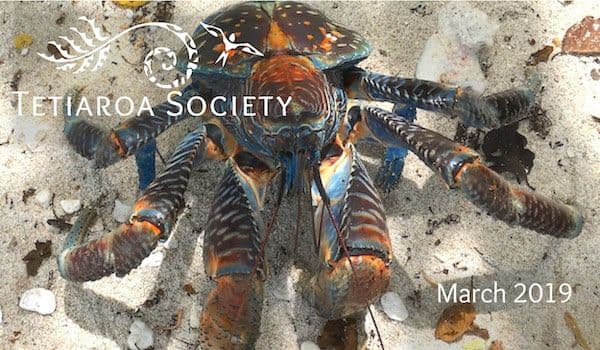
Coconut Crab
Photo credit: Nick Rodden
“There is a land crab that you can figure generally on being twice as big as your head. These creatures have very powerful claws and they can open a coconut by crushing the shell. They are also delicious to eat, but should they find their way into your bed, you would be advised to leave immediately. They will fasten onto whatever part of the body is available and their grip can only be released by tickling their behinds.” explains Marlon Brando, in his notes for his atoll, Tetiaroa.
This excerpt from M.B’s notes for his atoll, Tetiaroa, is a perfect summary of what characterizes a coconut crab. The most striking thing about these crabs is how big they can grow, which gives them the distinction of being the largest land crabs in the world. The biggest coconut crab ever recorded had a 1m (3ft) leg span and weighed 4 kg. They are also extremely powerful, their claws are strong enough to cut open a coconut to eat it, hence their name.
Learn more about coconut crabs
Culture speaks through Archaeological sites
Teturoa, its ancient name, has always been a very important cultural site for Polynesian people. This former getaway of the Polynesian elite is filled with the remains or ancient ceremonial sites and homes with over 100 ancient structures so far cataloged on the island. These structures have been identified and mapped by different archaeologists since 1962. Tetiaroa Society and archaeologists they collaborate intend to reconstruct the history and evolution of Polynesian communities that settled on Tetiaroa from initial colonization until 19th century. Eventually, the project also intends to help Tetiaroa Society to manage the rich cultural heritage of the atoll. This will include featuring these sites in educational programs for the local community, but also for the guests of the Brando through archeological tours.
Who digs Archaeology?
In this feature the archaeology of Tetiaroa will be presented by Mark Eddowes in a lecture from the field and by Guillaume Molle and collaborators via a report that they submitted from their work in 2015.
Tetiaroa Society is very fortunate to have Mark Eddowes working with us both in the field and as a member of our Conservation and Sustainable Use Plan committee. Mark came to Tahiti in 1988 as a graduate student in anthropology at the University of Auckland in New Zealand. He spent the following years studying the prehistory of Polynesia, and prospecting, mapping, and excavating cultural sites throughout French Polynesia and the Cook Islands. Mark has worked off and on for the French Polynesia Minister of Culture and has done a lot of restoration work recently on important marae on Moorea and Tahiti. Beginning in 2014 Mark started working with Tetiaroa Society on Tetiaroa to survey all 12 motu for cultural sites. Following on earlier work done by Pierre Verin and Yoshi Sinoto, Mark was able to identify and map over 100 structures. When Mark is on Tetiaroa he often gives lecture for guests of The Brando and hotel staff.
Guillaume Molle is a Lecturer at the School of Archaeology and Anthropology at Australian National University. He completed his PhD at the University of French Polynesia and has done archaeological work throughout French Polynesia since 2012. His work on Tetiaroa will be continuing later this year.
Mark's lecture from the field
Read the Report from Guillaume and his collaborators
TS Film Series
The idea has become a reality
This is the first of a series of videos that TS will produce about research and conservation activities on the island. This one is a general introduction to Tetiaroa Society.
Hey donors ... Thanks for the goodies!
Thanks to generous donations to our education program, TS is now putting big smiles on the faces of the visiting students. Each student received a water bottle and a backpack. So, it is not only environmental awareness and fond memories that these students will carry back to their school on Tahiti.
Tetiaroa Society receives generous support from The Brando for our core operations, but our ability to carry out innovative programs depends on your help -- any amount is appreciated!
Tetiaroa Society is a US registered 501(c)(3) nonprofit organization (Tax ID #45-1080688). We host scientific research, develop and implement conservation and education programs, and curate the island's knowledge base. We partner with The Brando to establish Tetiaroa as a model for sustainability, where businesses, non-profits, scientists, educators and the local community work together for common goals. Our program objectives are summarized in our Conservation and Sustainable Use Plan, which is available on our website.
© 2019 Tetiaroa Society