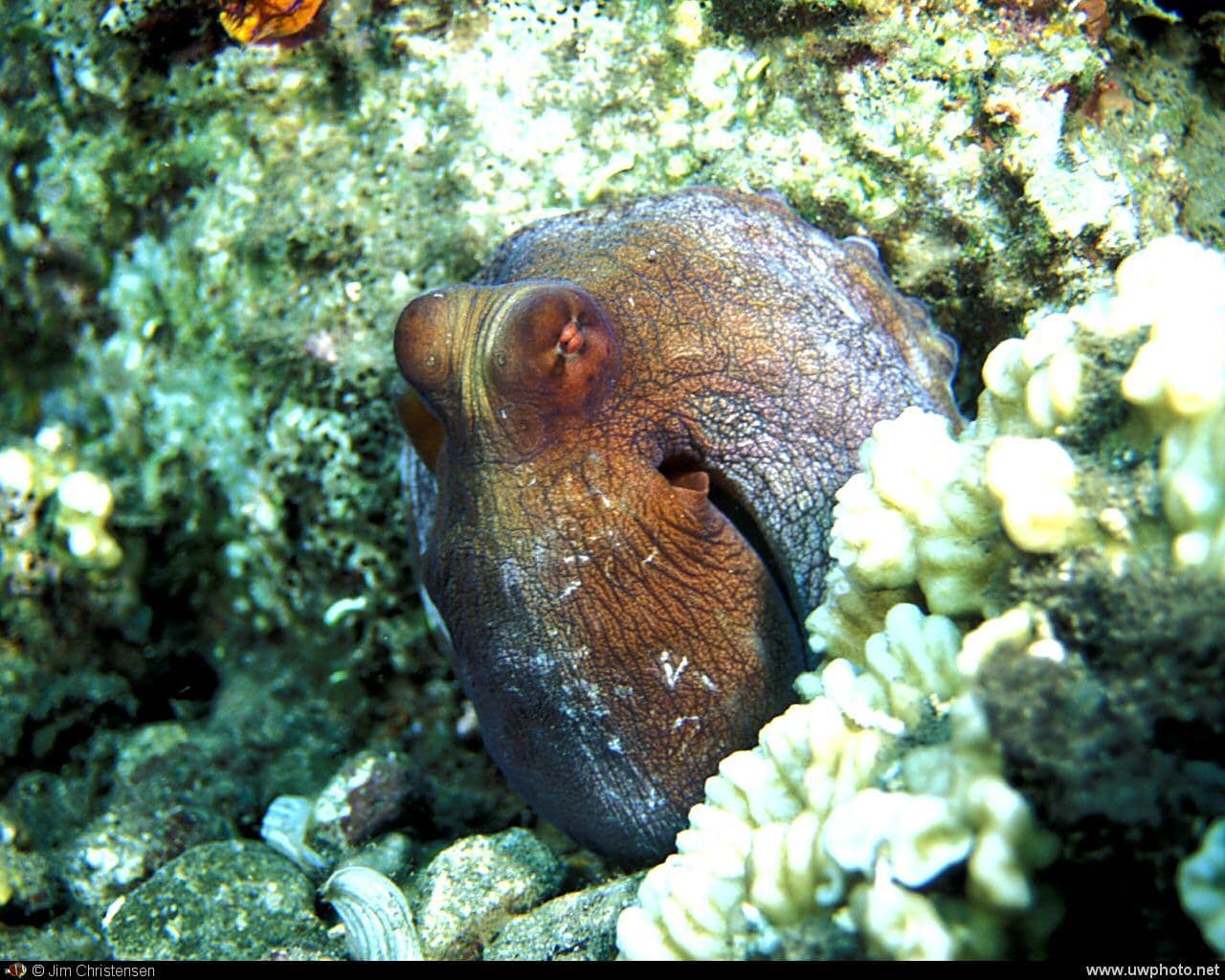
A patch of reef changes shape, grows arms and slips away. The day octopus hunts in full daylight, relying on camouflage that can copy both the colour and texture around it.
- Local names
- Fe’e
- Habitat
- Lagoon and reef
About this species
Octopus cyanea ranges through tropical reefs from Hawaiʻi to East Africa. It explores sand and rocky crevices for crabs, shrimps, clams and fish. Excellent eyesight works alongside touch and chemical sensing: receptors around the suckers let the arms investigate a surface and detect food.
The skin can rise into ridges and bumps that resemble coral, rock or algae. Once it captures prey, the octopus often returns to its den. Salivary venom subdues prey, a sharp beak breaks shells, and the rasping radula can bore into a shell so a secretion can loosen the animal’s attachment inside. A pile of discarded shells outside a den—sometimes called an octopus’s garden—is a useful sign of an occupied home.
One heart circulates blood through the body; two others pump it through the gills. Octopuses are known for complex behaviour and learning, although comparisons with the intelligence of unrelated animals are difficult to make.
The guide describes adults approaching 90 cm in length, a lifespan of roughly a year and a single breeding period. The young begin with a planktonic stage before settling into shallow coastal and reef habitats.