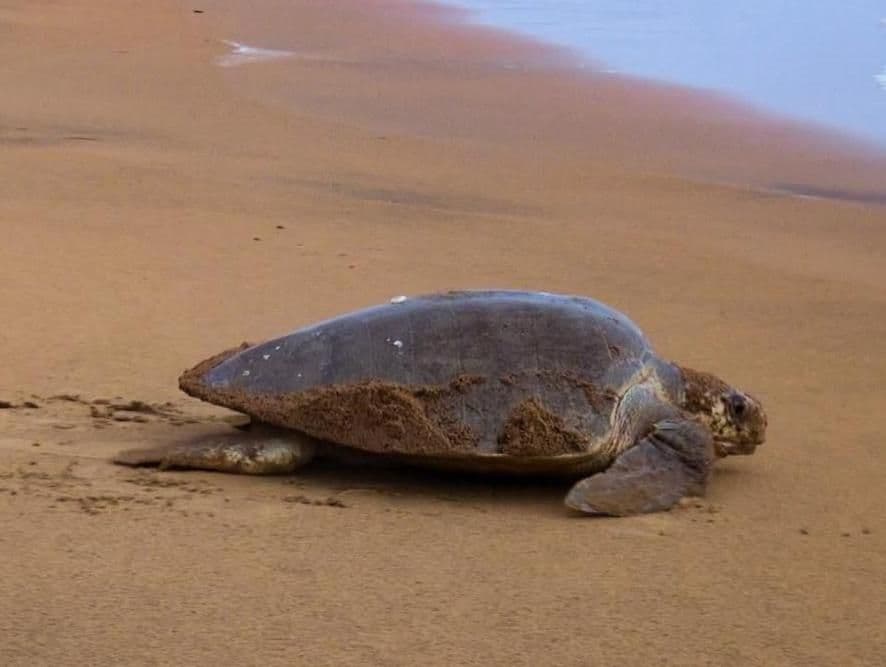
Some olive ridleys nest alone; others arrive together by the thousands. One male was recorded off Tetiaroa in 2018.
- Local names
- Honu
- Habitat
- Motu and shore
- Other names
- Legacy source name: Lepidochelys oliveacea
About this species
The olive ridley is among the smallest sea turtles. Its olive-coloured, heart-shaped shell gives it its name. It is one of the five sea turtle species recorded in French Polynesian waters.
It occurs through tropical parts of the Pacific, Indian and Atlantic oceans. The older guide broadly excludes the Caribbean from its principal range. Costa Rica, Mexico and India are among its well-known nesting regions.
Olive ridleys eat crustaceans, molluscs, fish, jellyfish, algae and other aquatic plants. They feed in coastal waters and in the open sea; the guide records adults at depths greater than 110 m, approximately 360 feet.
Maturity is reached at around fourteen years, though the age varies. Females may nest alone or join an arribada, a Spanish term for a mass arrival. Hundreds or thousands come ashore together to lay. A female may nest two or three times in a season, laying about a hundred eggs each time.
The guide reports a male caught off Tetiaroa in early 2018 and taken to the turtle clinic on Moorea. He did not survive. This is a dated individual record; it does not establish a resident population or a nesting site on the atoll.