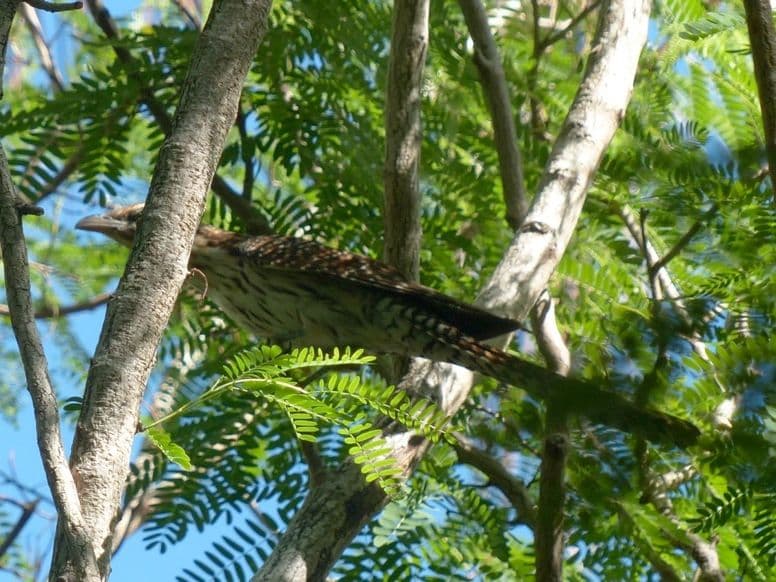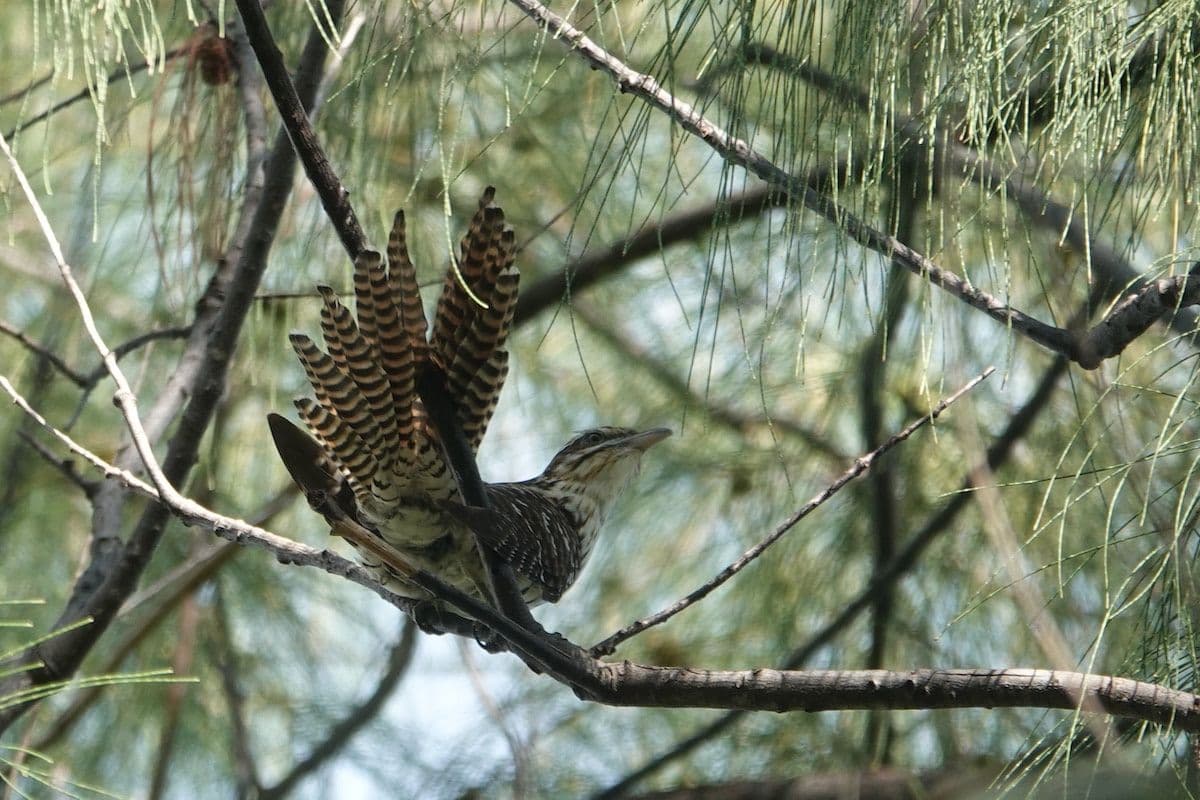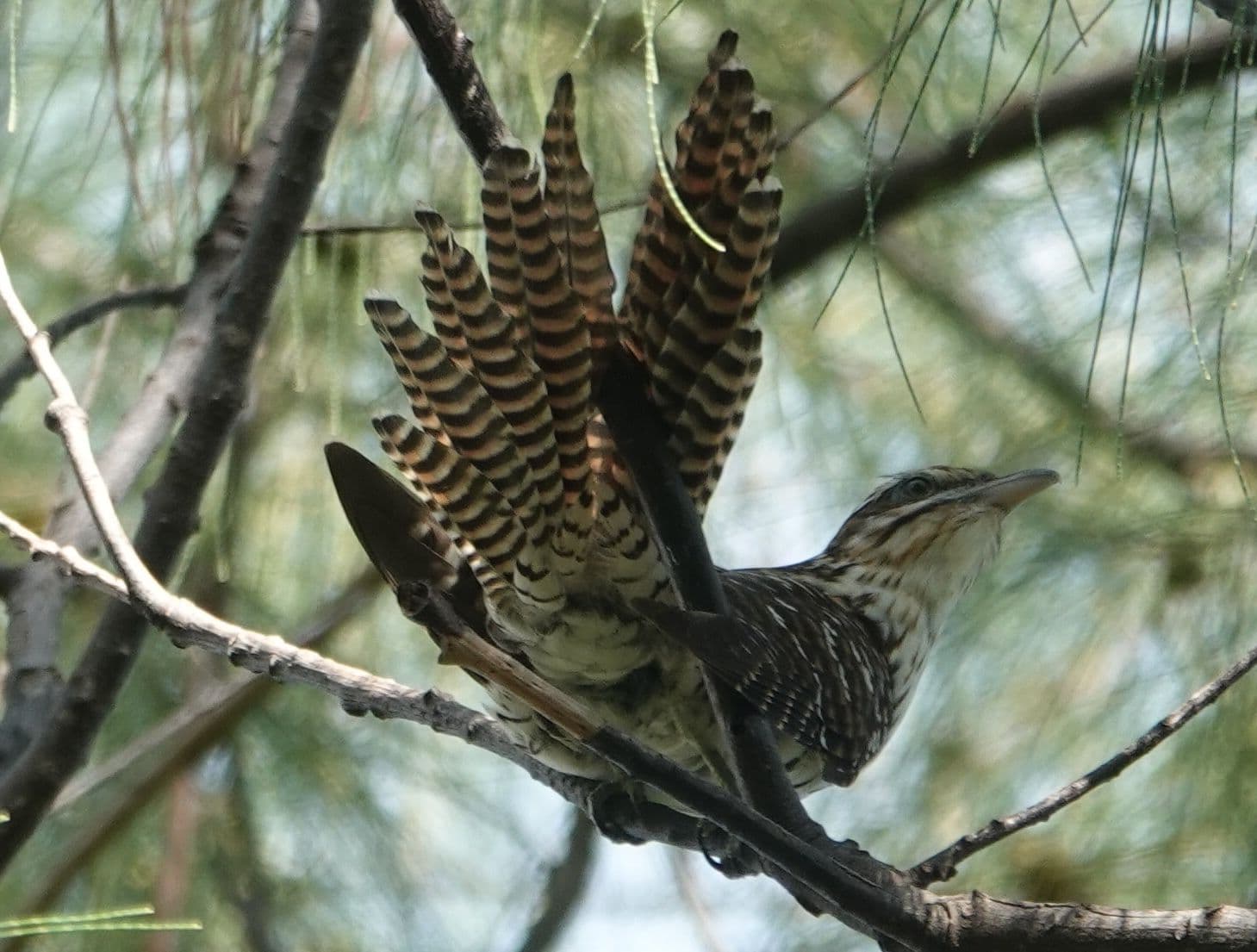
Its long, harsh call often reveals a bird that stays hidden in the canopy.
- Local names
- ‘Arevareva
- Habitat
- Motu and shore
- Other names
- Coucou de Nouvelle-Zélande; Legacy source name: Eudynamis tahitiensis
About this species
The Pacific long-tailed cuckoo is about 40 cm long, much of that length in its striking tail. Brown upperparts carry reddish bars and pale spots; the breast and belly are pale with dark brown streaks. Secretive and often solitary, it is seldom seen closely on Tetiaroa, though its loud call can carry from the canopy.
It eats insects, lizards, eggs and the young of other birds.
The species breeds in New Zealand during the southern spring and summer, broadly September–March, with most eggs laid in November–December. It spends the other part of the year across the tropical Pacific. The guide records arrivals in French Polynesia in March–April and departures in September–October; a few birds remain rather than making the return journey.
Females build no nest. Each egg is placed in the nest of another bird, including New Zealand’s endemic Mohoua songbirds, and resembles the host’s eggs. The host parents raise the cuckoo. This is brood parasitism: another species supplies the nest and raises the young. Accounts describe the loss of the host’s eggs or young, but the details of early development and exact incubation time remain poorly documented.
The guide calls it a bird of rain because its prolonged shriek was associated with approaching wet weather. In an account recorded by Teuira Henry, ‘Ārevareva embodied the creator Ta‘aroa. A brief call near a house was to be answered with “Ta rua!”—“Repeat!” Failing to answer was said to anger Ta‘aroa and endanger a sick member of the household.