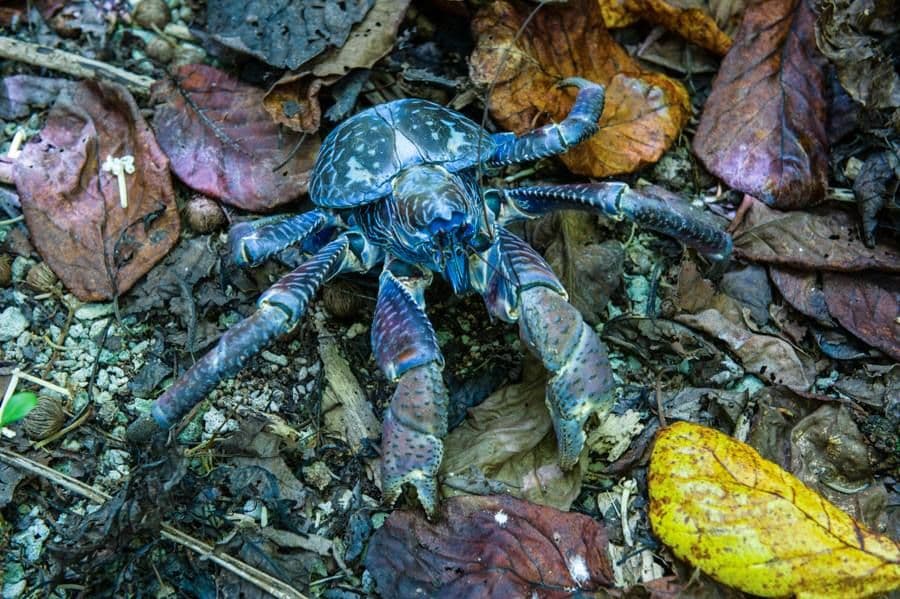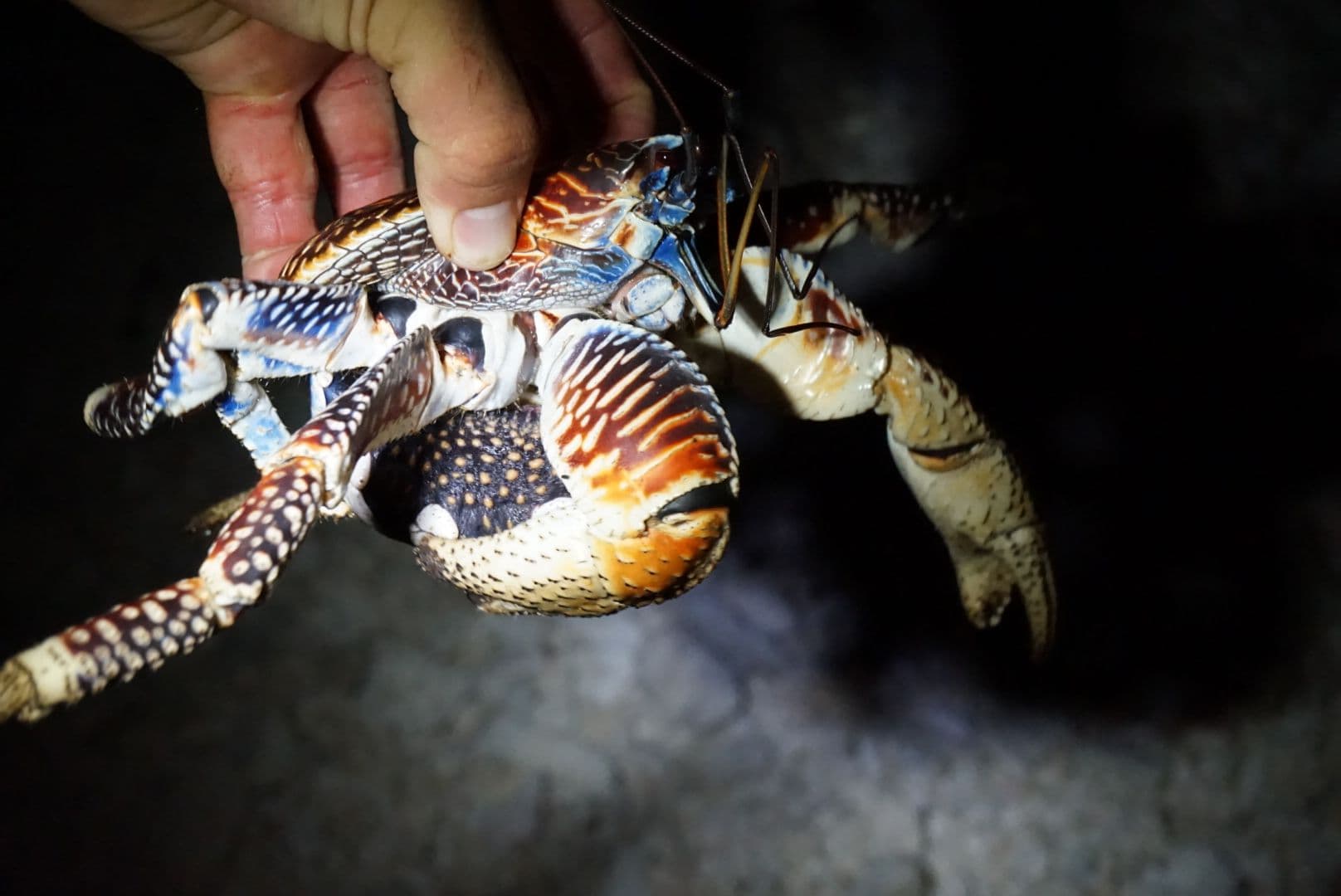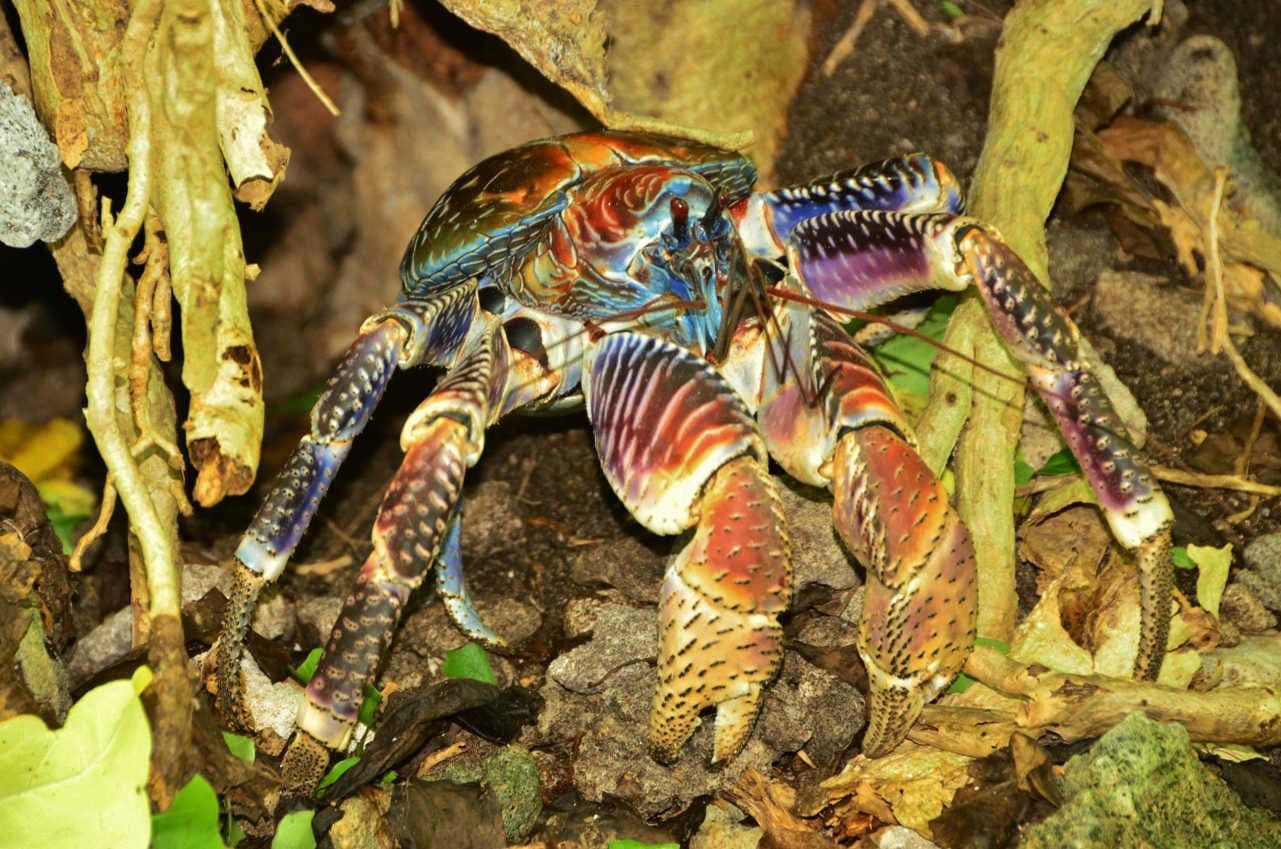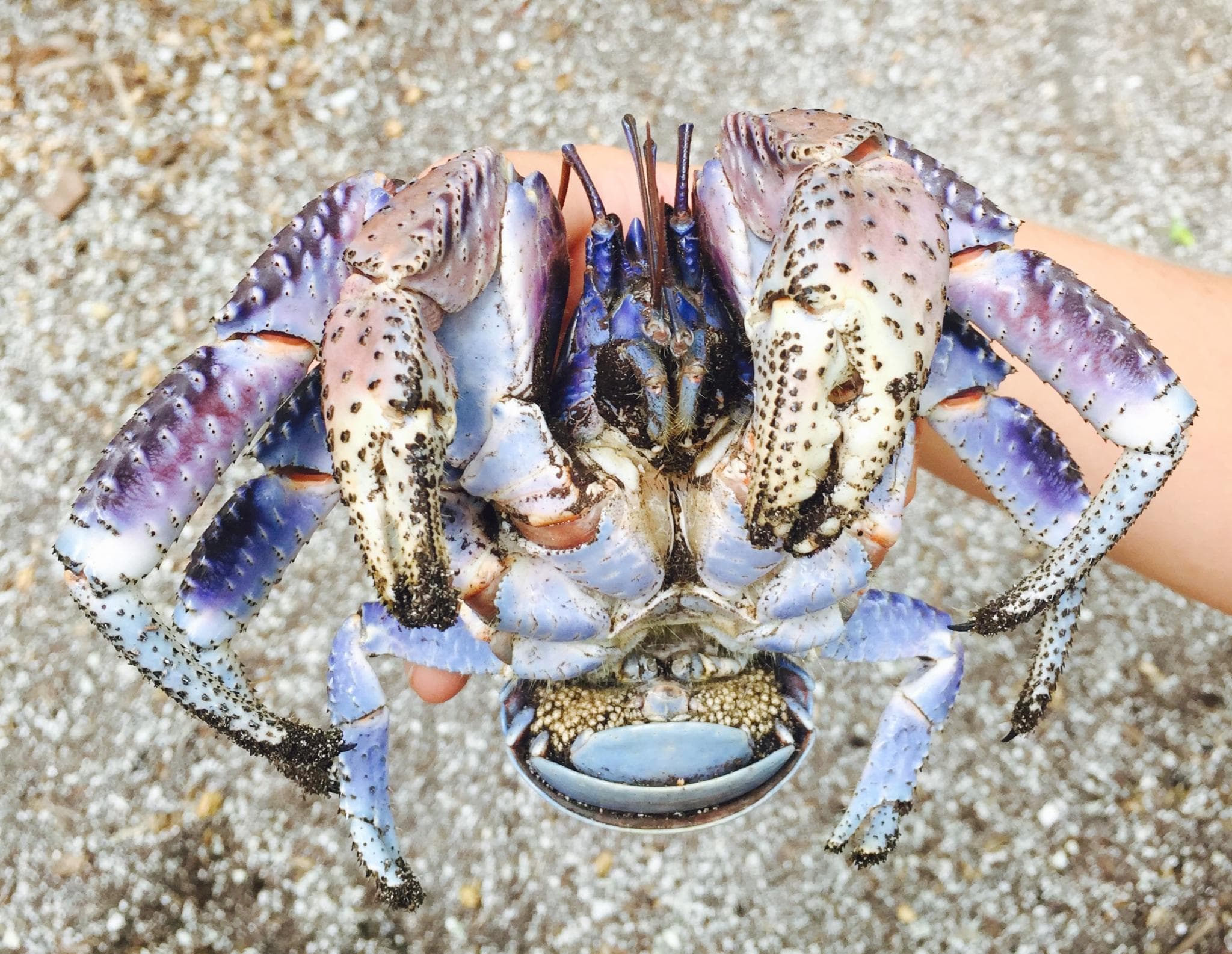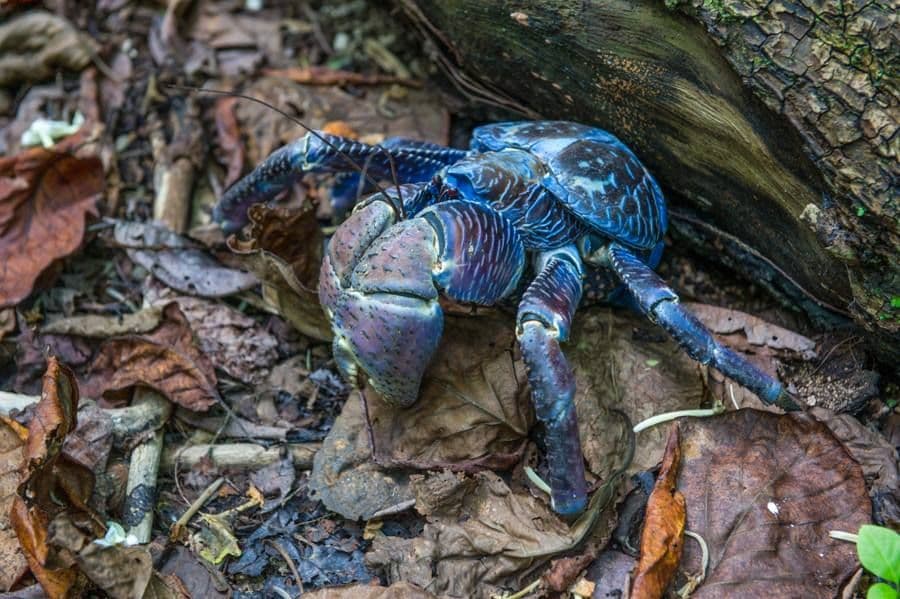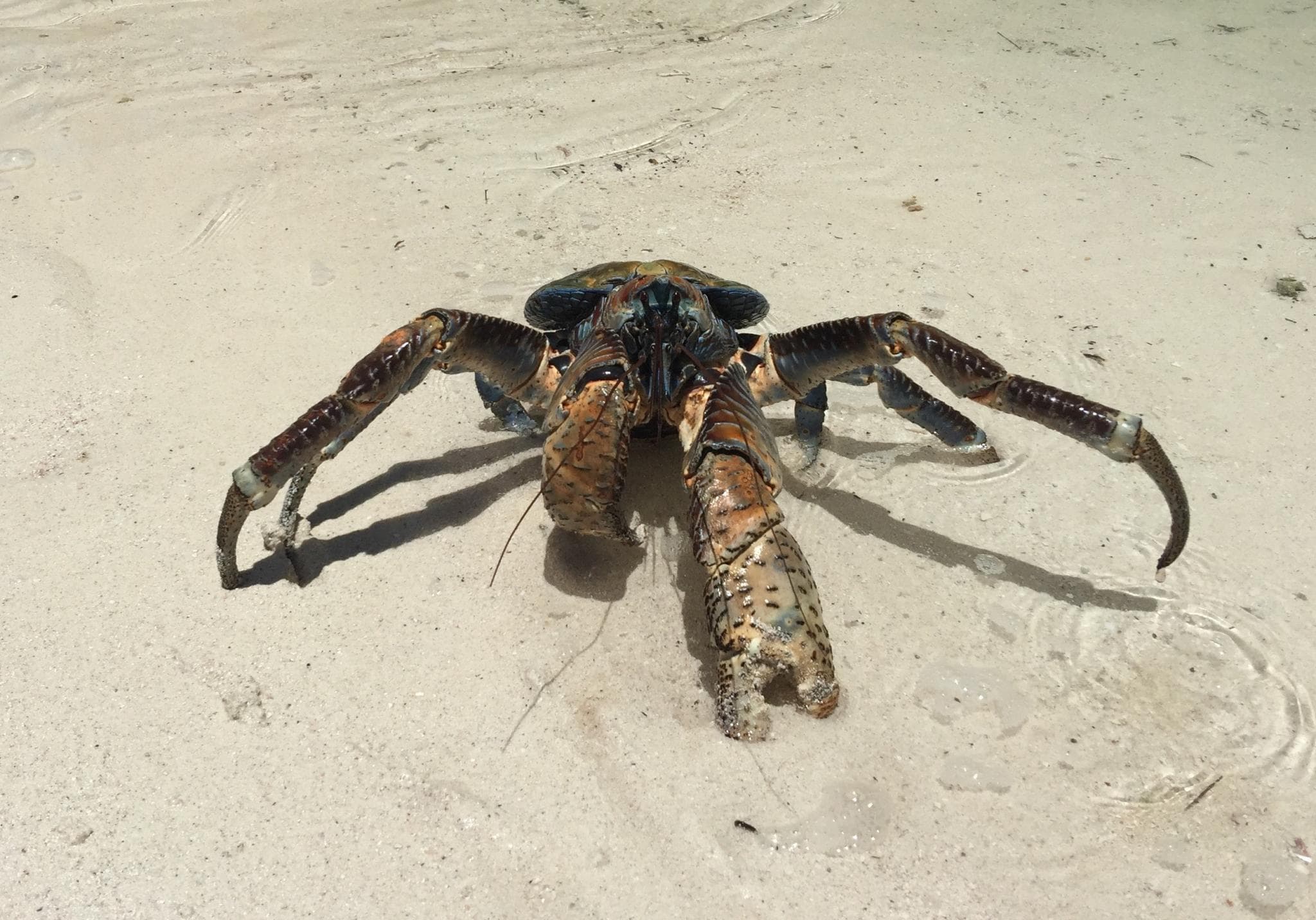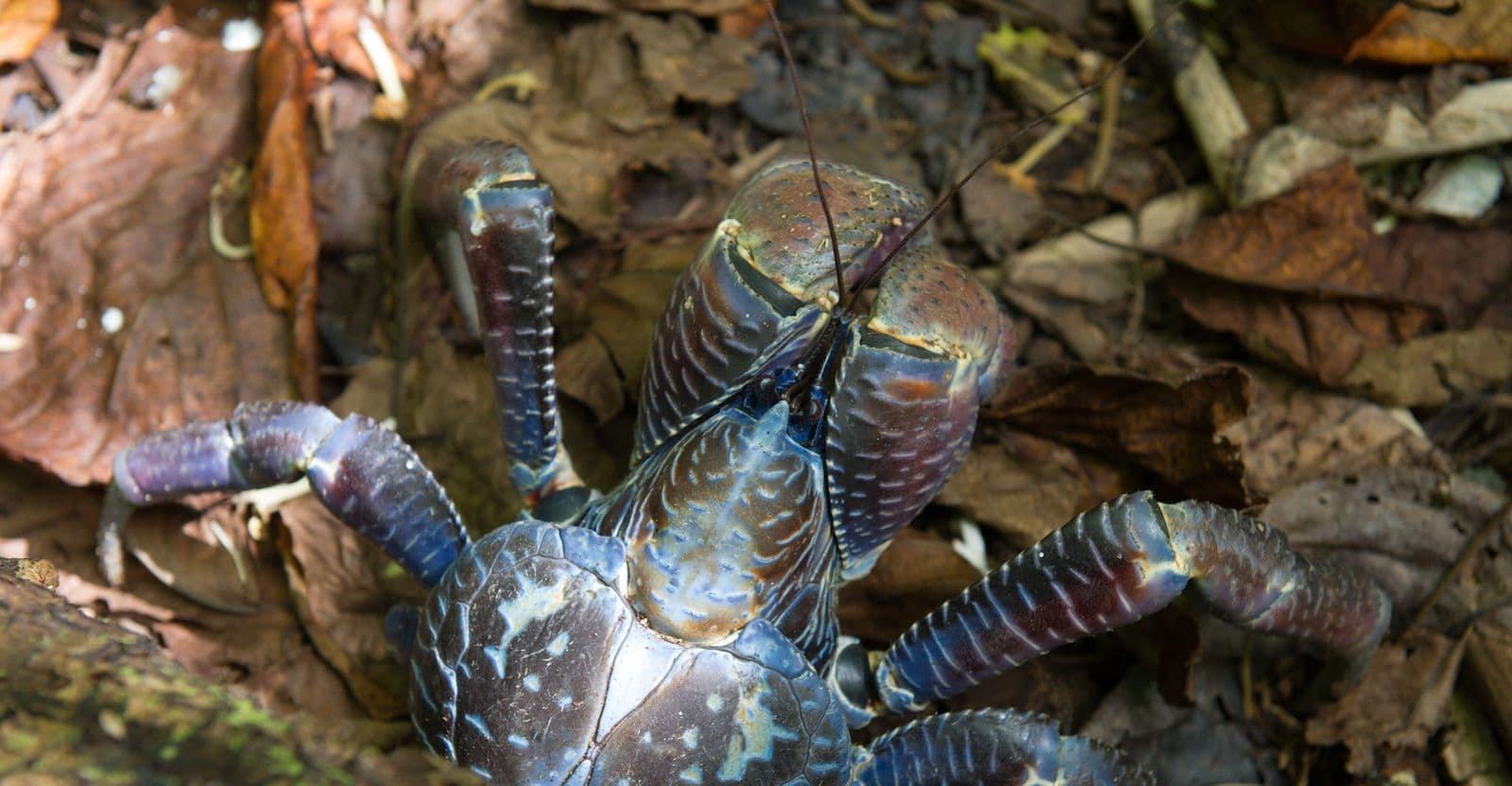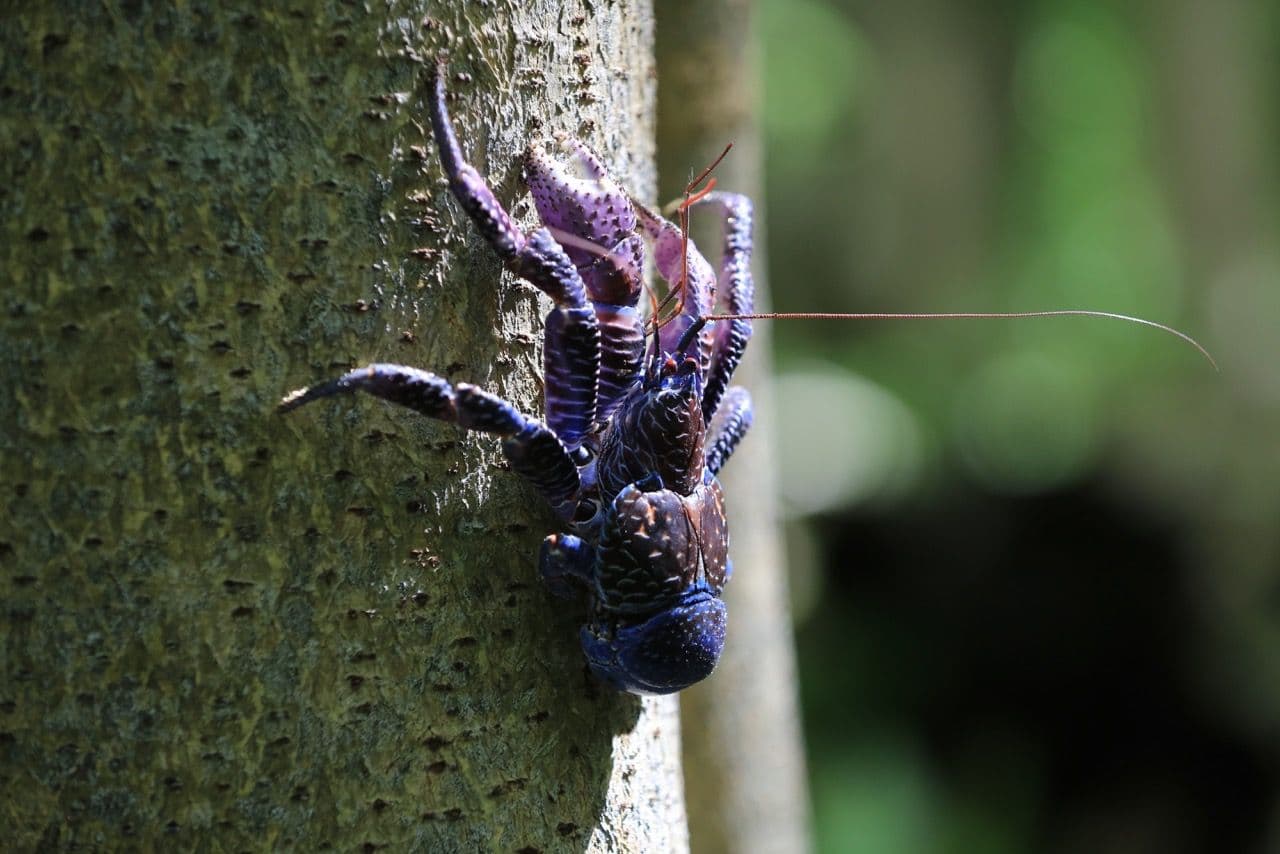
At night, a fallen coconut can draw the largest land-living arthropod in the world out of the forest. The kaveu belongs to the hermit-crab family, but adults carry no borrowed shell.
- Local names
- 'aveu (Society Islands), Kaveu (Tuamotu Islands)
About this species
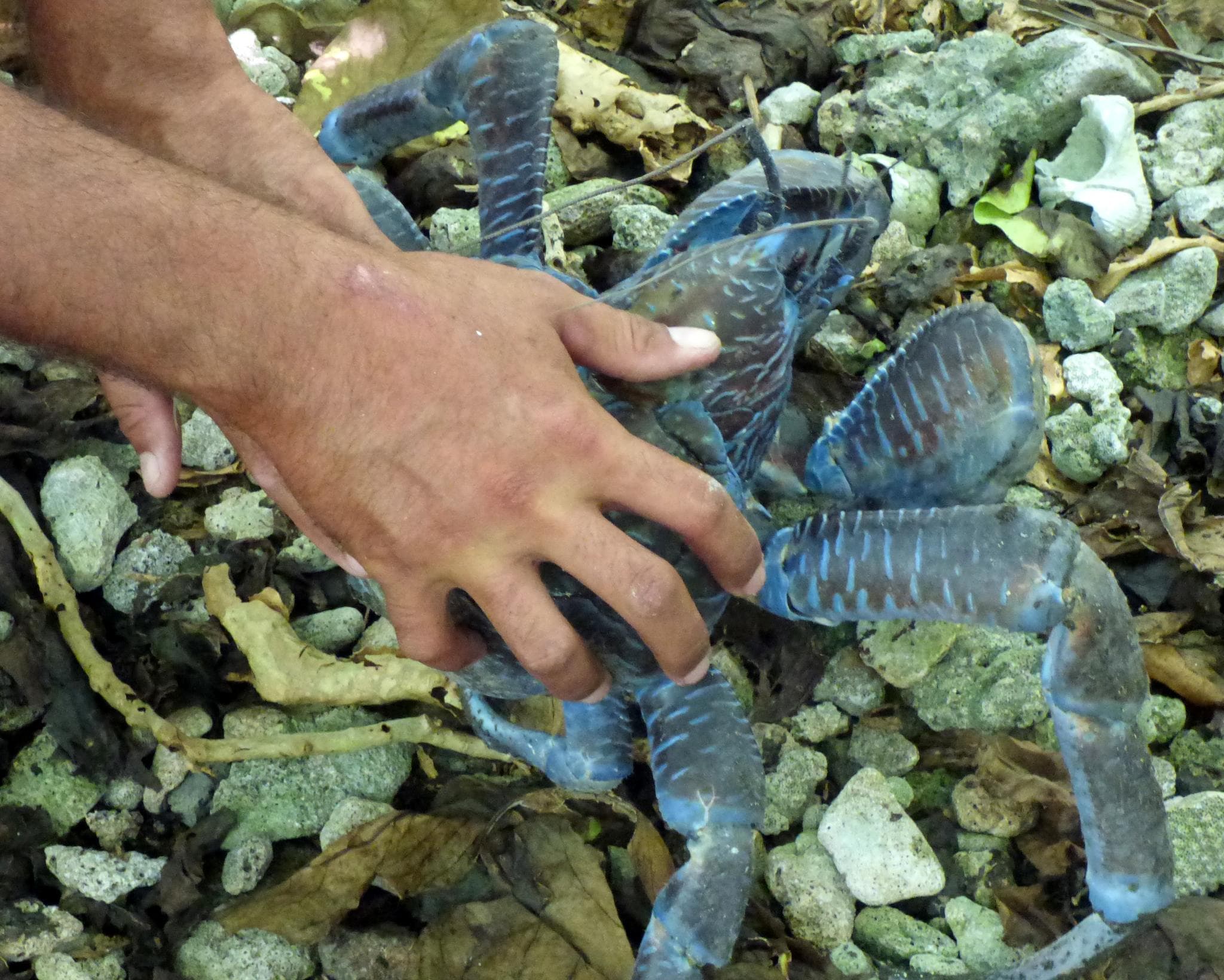
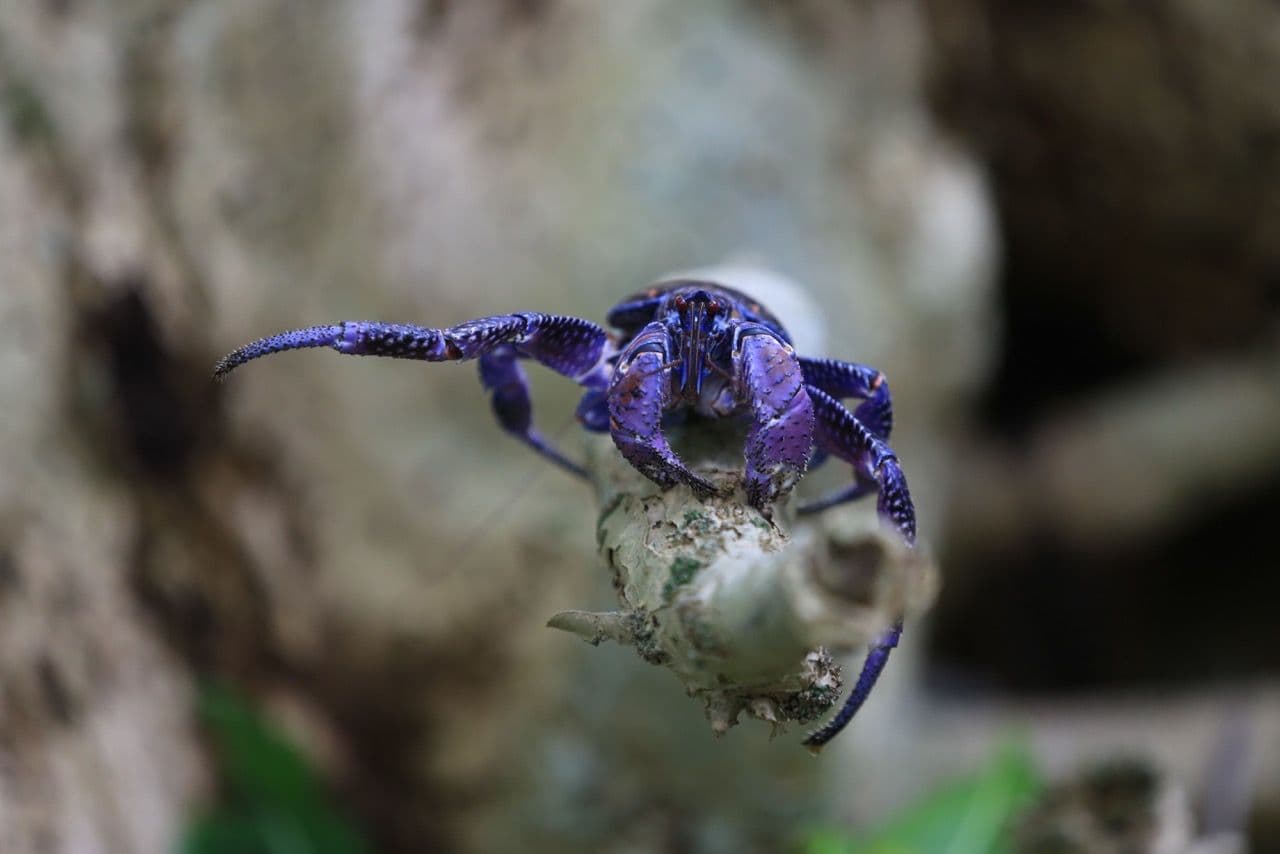
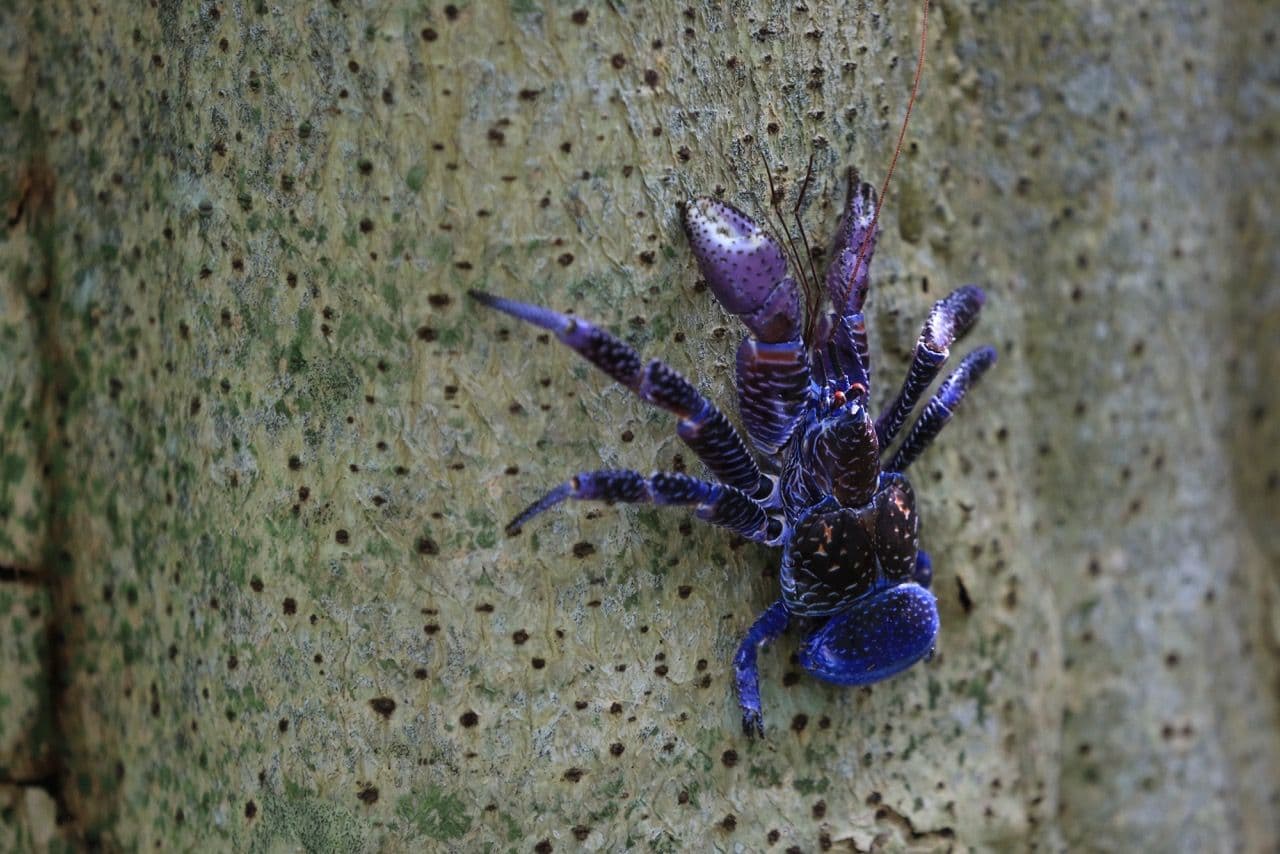
An adult may span a metre from leg to leg, with a body around 40 cm long, and weigh around 4 kg. Blue is familiar, but individuals also show orange, red, purple, brown or nearly black colouring. On Tetiaroa, the Society’s observations describe coconut crabs on most motu, with larger populations in the north. They shelter in holes, burrows and trees, often freezing rather than revealing themselves.
Young coconut crabs protect their soft abdomen with empty shells, sometimes using plant material. Successive moults add protective chitin until they can dispense with a shell, at roughly a year old. As they grow, they move farther into the forest. They retreat underground to moult, a vulnerable process that can keep them hidden for about a month.
Mating takes place on land. The Society’s older natural-history notes describe repeated mating between May and September, a male turning a female onto her back for mating lasting about 15 minutes, and females carrying roughly 50,000–150,000 eggs beneath the abdomen on hairy appendages called pleopods. These seasonal dates describe the source observations, rather than a fixed calendar for every population.
After roughly a month of brooding—the guide gives a range of 25–45 days—the female releases her brood at the sea’s edge, often around the new moon. The larvae, called zoeae, spend roughly three to four weeks in seawater before settling and beginning their shell-carrying stage. Adult life is terrestrial, but reproduction keeps the species tied to the ocean.
A branchiostegal lung allows the crab to take oxygen from air. Its moist, gill-like tissue still needs water. A powerful sense of smell helps it locate food; its smell receptors have features more like those of insects than of many aquatic crabs.
The older guide describes three moults in the first year, a move farther into the forest at around three years, and sexual maturity at about five. Adults may dig a moulting chamber around 50 cm below the surface. These are approximate developmental observations, not exact milestones for every crab. The French source describes nocturnal activity, annual moulting and a typical lifespan of roughly 40–60 years. Their slow growth and complex life cycle make heavily harvested populations slow to recover.
The animal has long been prized as food in Polynesia. The Society’s cultural notes also describe coconut crabs as manifestations of local gods. Its scientific name, latro, means “robber”, a reference to its scavenging habits.
VERDUCCI Magalie. DIREN. Réserve de Biophère de Fakarava. 2013. Crabe de cocotier (Birgus latro)