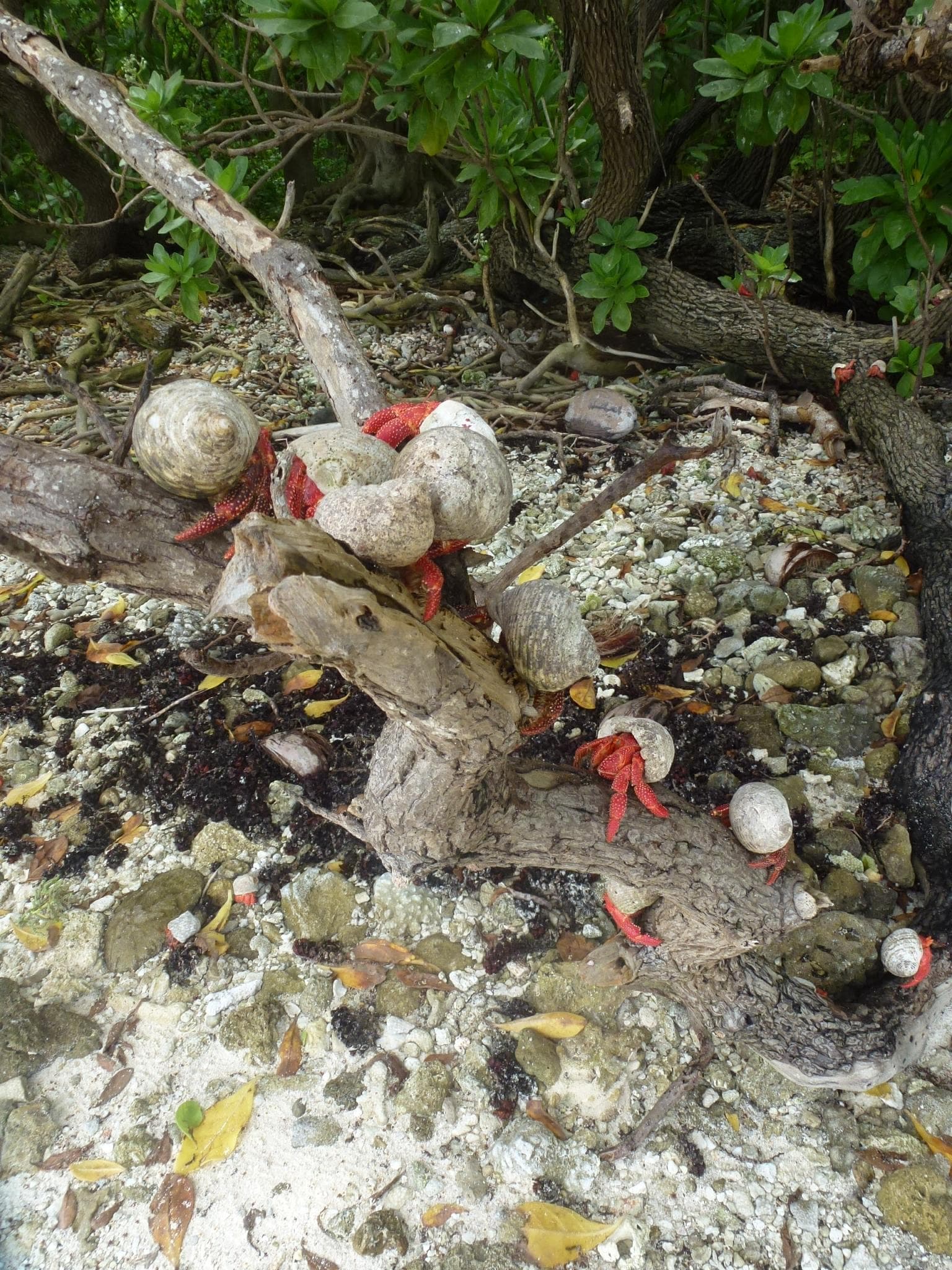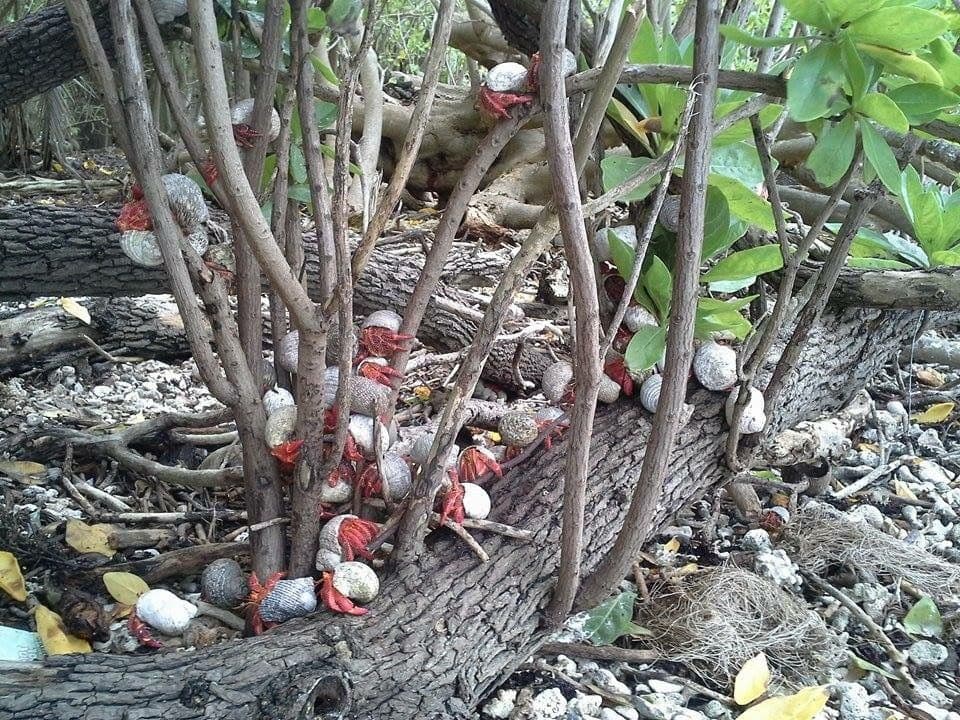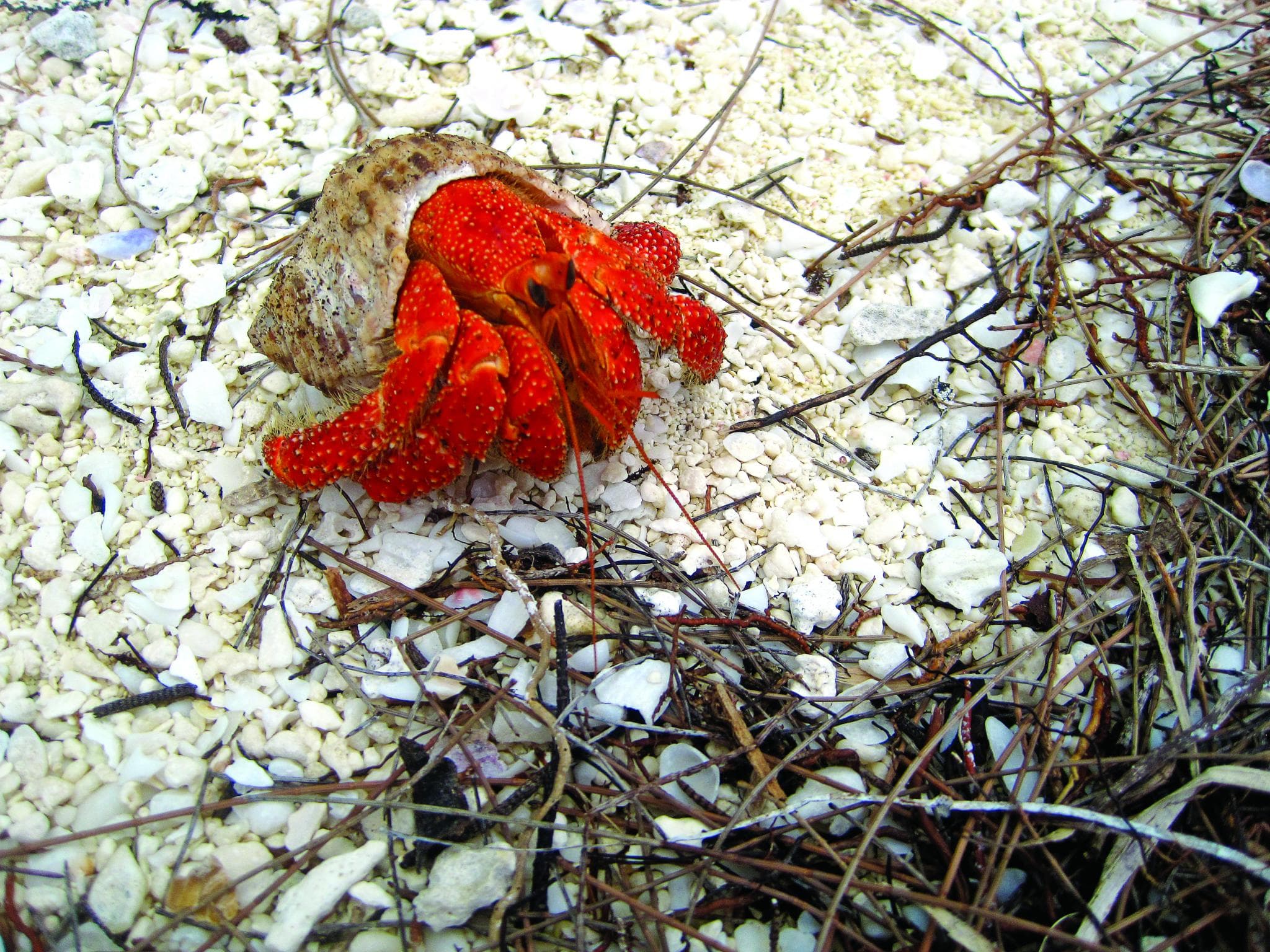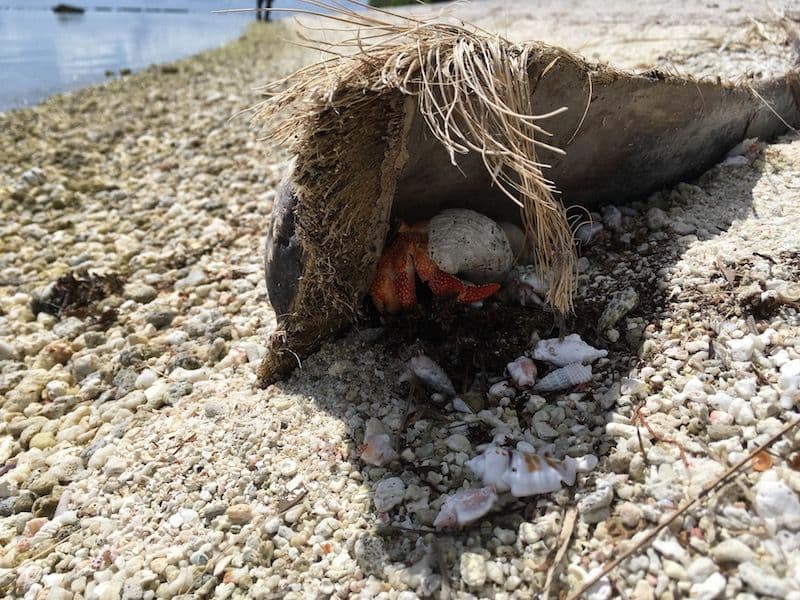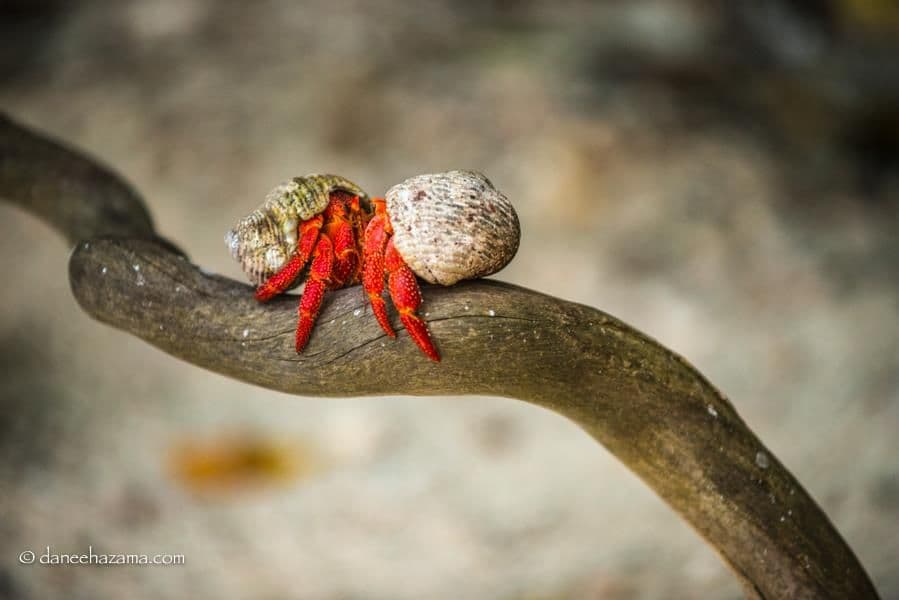
A bright red crab steps across the beach with a shell on its back. On Reiono, these shoreline scavengers can gather in remarkable numbers.
- Local names
- Uà
- Habitat
- Motu and shore
About this species
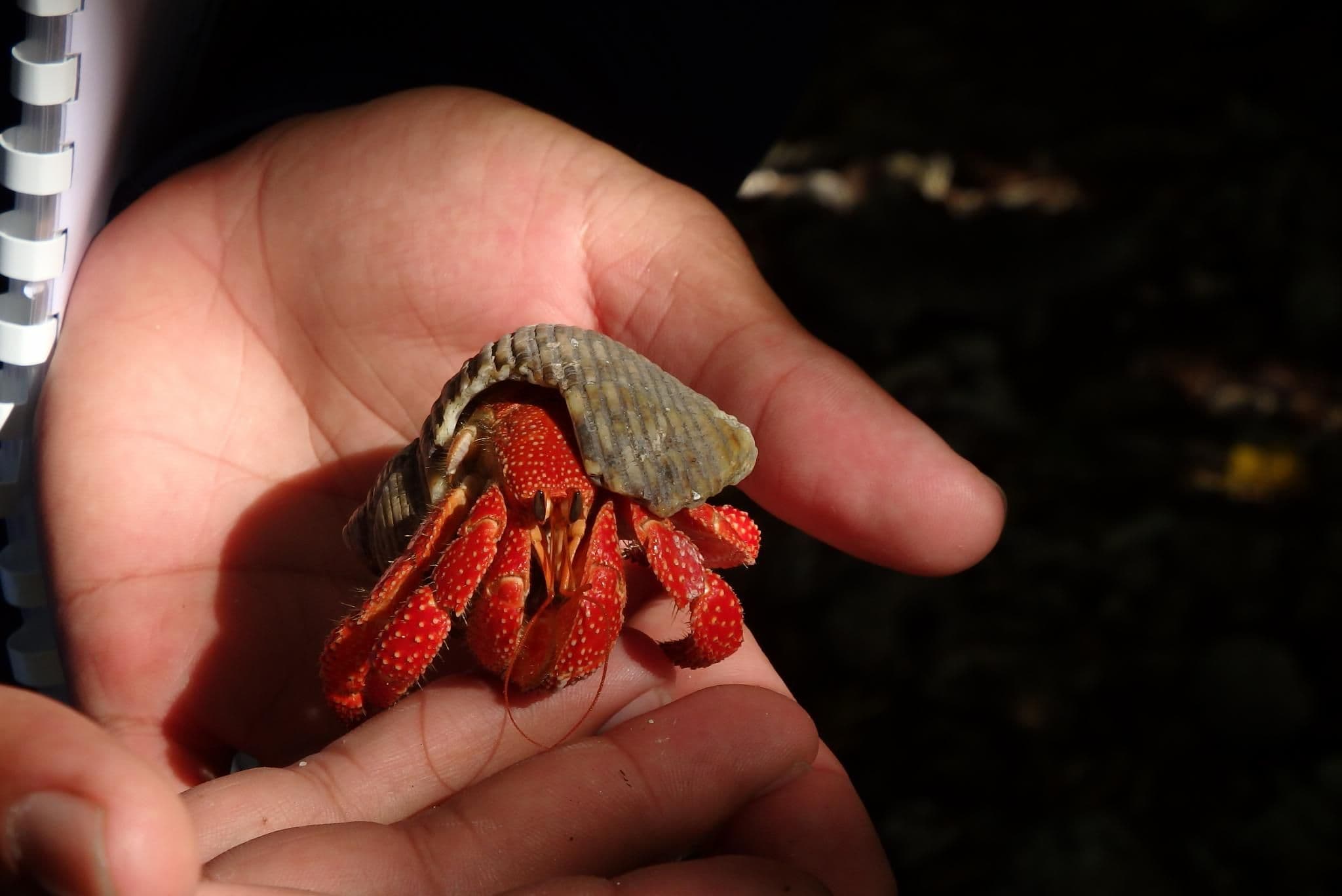
Coenobita perlatus is an Indo-Pacific land hermit crab in the same family as the coconut crab. Adults can reach about 8 cm and 80 g. Fine granules cover the body; the familiar strawberry red varies with age and dietary carotenoids, and young animals may be much paler. The guide also records orange and darker individuals.
An abandoned marine-snail shell protects the soft abdomen and internal organs while holding the moisture the crab needs. A close fit matters. Like other decapods, it has five pairs of legs modified for grasping, walking, holding the shell and cleaning. Two pairs of antennae help it sense its surroundings. Sex is difficult to determine without seeing the underside outside the shell, where the genital openings are located at the bases of the legs.
These crabs favour beaches, coastal dunes and nearby ground within reach of seawater. They need salt water for moisture, breathing and salt balance. They are most active at night, reducing water loss, and can remain tucked inside their shell through difficult conditions.
Plant debris, dead animals and other organic remains make up much of their food, helping clear the shore. They also take live prey, including newly hatched sea turtles. Groups can contain dozens or hundreds of crabs. The Society’s guide describes shell exchanges in which a larger animal moves into an empty shell and a succession of smaller crabs occupies the shells left behind.
During mating, the male places a sperm packet, or spermatophore, on the female. As it dissolves, the eggs are fertilised. She carries them on abdominal appendages called pleopods and keeps them moist. The guide describes release on a wet rock, where the rising tide carries the eggs into seawater to hatch. The larvae develop at sea; after settlement, a young crab must find a protective shell.
The original accounts give a wild lifespan of about 25–30 years, with another passage giving a possible lifespan near 40 years. Captive survival is often shorter. Reproduction requires a marine larval stage and is difficult to reproduce in ordinary captivity.
McKenzie, N. 1999. "Coenobita perlatus" (On-line), Animal Diversity Web. Accessed November 14, 2017 at http://animaldiversity.org/accounts/Coenobita_perlatus/