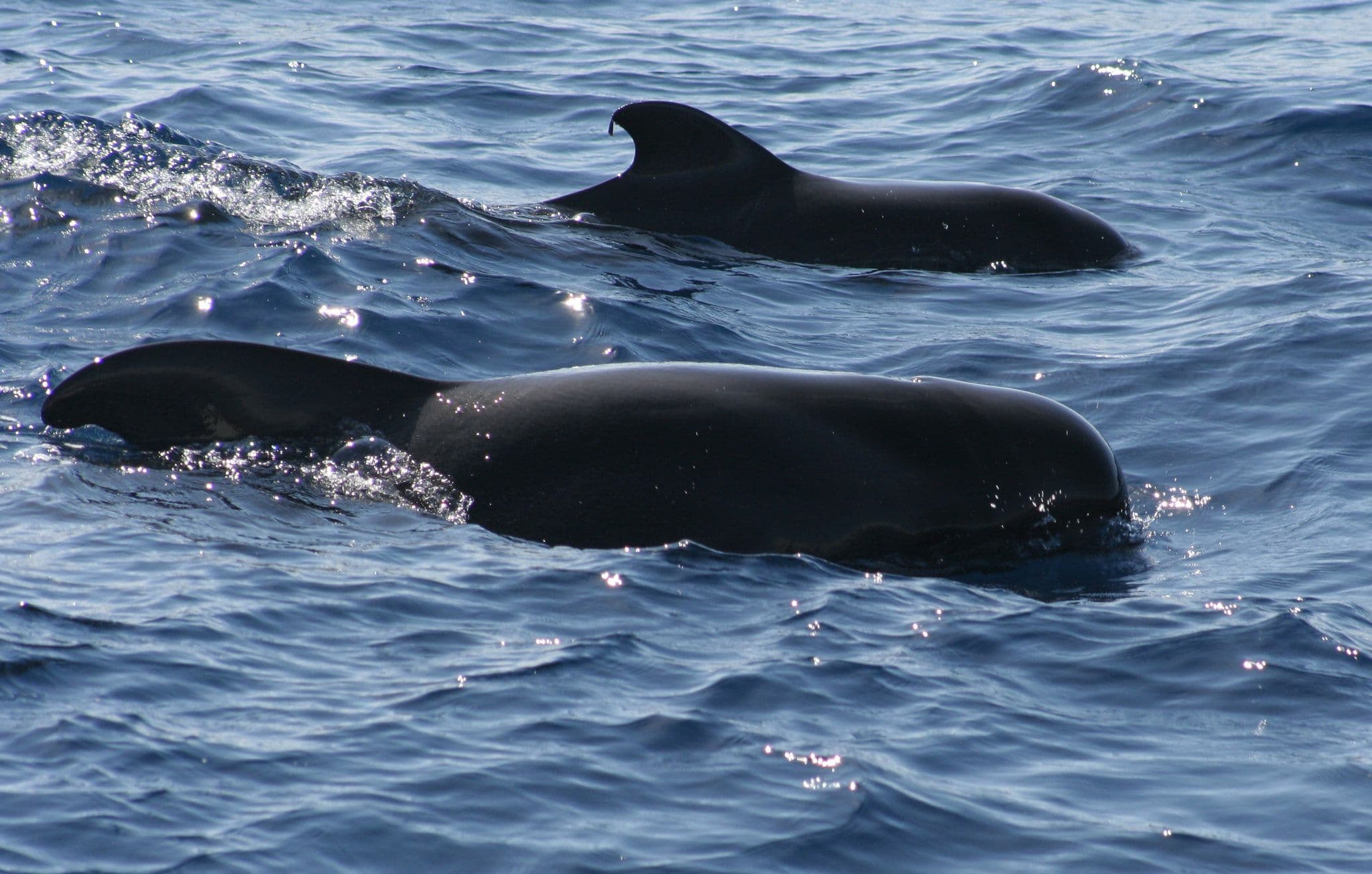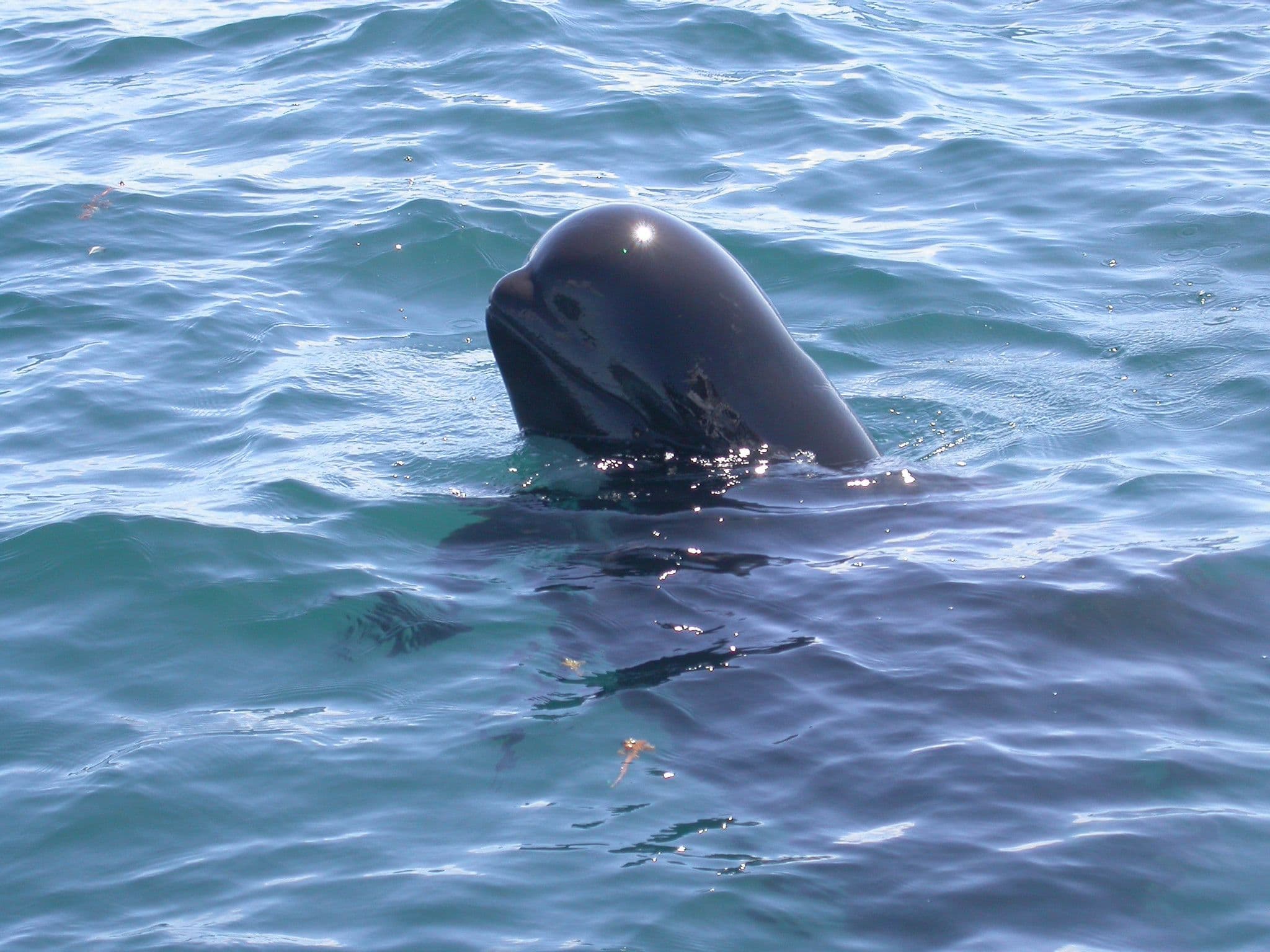
A life measured in decades, held together by a close-knit family: the pilot whale’s social world is as striking as its deep dives.
- Habitat
- Open ocean
About this species
The short-finned pilot whale belongs to the dolphin family. Its bulbous forehead has no obvious projecting beak, and the broad-based dorsal fin sits well forward on the body. Black to dark brown, it has a grey saddle behind that fin.
Adults weigh about one to three tonnes. The guide gives typical lengths of roughly 3.7 m for females and 5.5 m for males, with large males reaching about 7.3 m; the French account’s 3.5–6.5 m describes a more typical range.
The guide records pilot whales throughout the year, especially in the Marquesas, Tuamotu, Society and Austral islands, both offshore and near the coast. It describes closer approaches to reefs during the humpback season, June–November, including interactions with humpbacks.
They chiefly hunt squid, often at night, and also take octopus and fish. Feeding dives commonly reach 300 m or more; the local account describes dives around 600 m and breath-holds of up to 30 minutes. Travelling or feeding groups can spread into lines roughly a kilometre across.
The guide also describes pilot whales taking bait or hooked fish from Tahitian fishing lines, using echolocation while foraging. That behaviour can bring whales into conflict with fishers and does not make them immune to hooks or entanglement.
Groups are centred on related females. Counts vary: the French account describes groups of 10–40 animals around the islands, while the English profile gives 25–50 as a common group size. Females may stay with their birth group for life; males are more likely to leave. Males can mate with several females, and the guide cites approximately one mature male for every eight mature females in some groups.
Older females hold an important place in these societies. Females can live around 60 years or more, compared with roughly 40–45 years for males. Some survive for many years after reproduction ends. This post-reproductive life is not unique to pilot whales and humans: it also occurs in several other toothed whales.
Strong social attachment may contribute to mass strandings, although following a leader is not a complete explanation for every event. The guide links the English name “pilot whale” to the sight of these animals swimming ahead of boats.
Maturity comes at around ten years. Gestation lasts approximately 15 months; a calf nurses for at least two years. Females commonly calve every five to eight years, within the wider three-to-nine-year interval given in the English source. Older females reproduce less often, and a mother’s last calf may continue nursing for as long as 15 years.
The regional account also describes older females helping nurse young, adding to the picture of care shared within a closely bonded group.