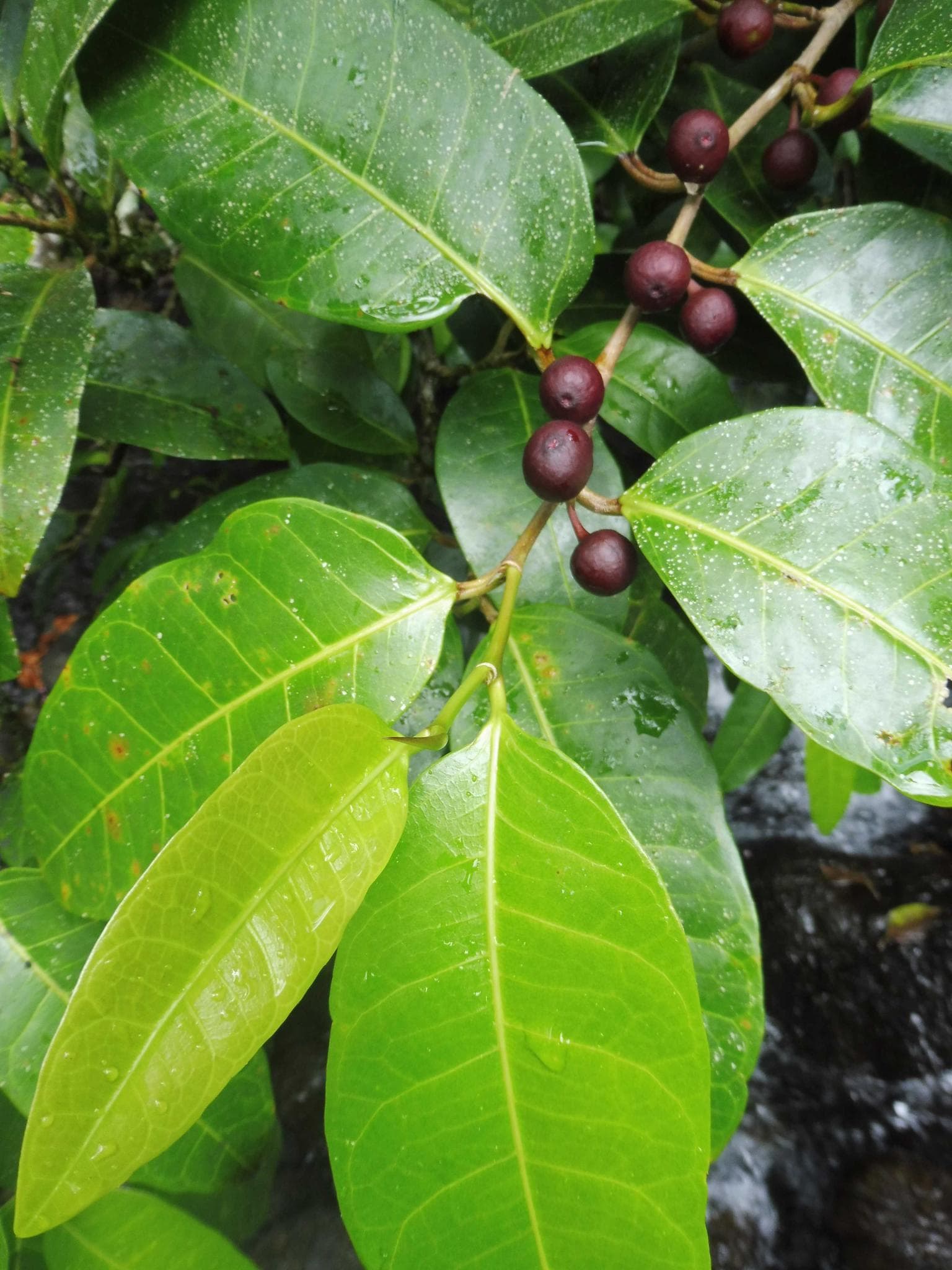
The small figs of mati can colour cloth and skin. Its roots and tough bark make this shore-side fig distinctive in other ways too.
- Local names
- Mati (Society Islands, Austral Islands, Tuamotu Islands)
- Habitat
- Motu and shore
- Family
- Moraceae
- Biogeographical status
- Polynesian introduction (legacy inventory)
- Life form
- Tree
- Abundance
- Uncommon
- Ecosystem
- Mixed forest
About this species
Mati often grows on rock, a habit called saxicolous. It develops aerial roots and was compared to a small banyan by Teuira Henry, cited in the guide’s 2004 edition.
The fruits are edible. Combined with tou leaves (Cordia subcordata), they yield a reddish dye traditionally used on tapa bark cloth and skin. The guide also records medicinal associations for the figs, without specifying a treatment. Fibres from the bark make strong fishing nets and cordage.
Barrau, 1971. Useful plants of Tahiti. Société des Océanistes, Paris, Dossier 8.
Butaud J.F., Gérard J., Guibal D., 2011. Guide des arbres de Polynésie française, bois et utilisations. 2e édition, Au vent des îles.&
Butaud J.F., 2013. Vallées tahitiennes, Guide floristique. Direction de l’environnement.
Jost X., Ansel J.L., Raharivelomanana P., Butaud J.F., 2016. Ethnobotanical survey of cosmetic plants used in Marquesas Islands (French Polynesia). Journal of Ethnobiology and Ethnomedicine.
Photo: Jean-Yves Hiro Meyer