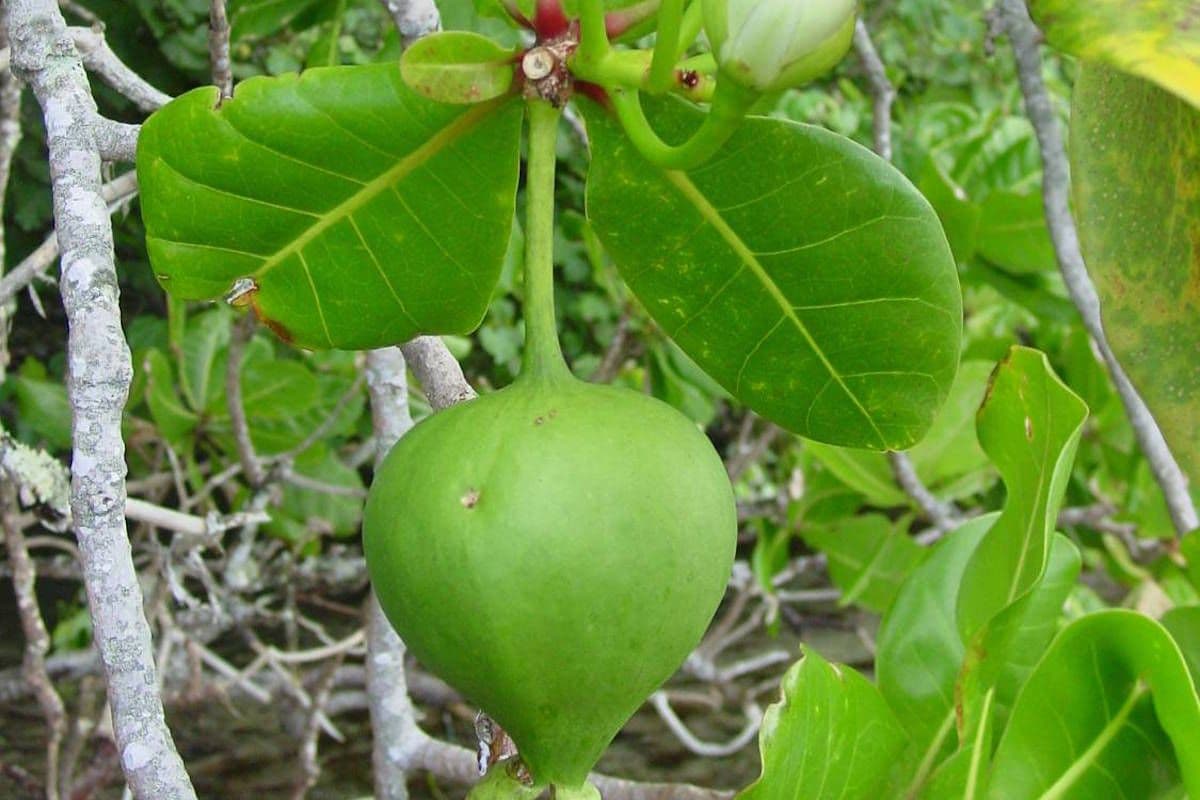
Its floating fruit carries the fish-poison tree from shore to shore. Its wood, flowers, and place in Polynesian traditions tell a much broader story.
- Local names
- Hutu (French Polynesia), Hotu (French Polynesia)
- Habitat
- Motu and shore
- Family
- Lecythidaceae
- Biogeographical status
- Indigenous
- Life form
- Tree
- Abundance
- Uncommon
- Ecosystem
- Mixed forest and beach
About this species
Often found beside the sea, the tree disperses through buoyant fruits containing an almond-like seed. Its pale-yellow wood is light and soft, used for canoes, building, joinery, and fuel. Flowers and leaves provide ornament.
The floating fruit lies behind the expression hotu painu, recorded in the guide as a disapproving description of someone without attachments. Another tradition gives the tree its origin in a human heart.
The seeds contain saponins, naturally occurring substances with detergent-like properties that can damage cells. Historical fishing practices used the grated seeds to stun or kill lagoon fish. The guide also records external traditional applications for stonefish (nohu) stings, sprains, headaches, and wound care; these are accounts of traditional use rather than evidence of clinical effectiveness.
Butaud J.F., Gérard J., Guibal D., 2011. Guide des arbres de Polynésie française, bois et utilisations. 2e édition, Au vent des îles, 616 p.
Barrau J., 1971. Useful plants of Tahiti. Société des Océanistes, Paris, Dossier 8, 33 p.
Butaud J.F., 2014. Guide floristique, Rimatara, Rurutu, Tubuai, Raivavae. Direction de l’environnement, 1e édition, 131 p.