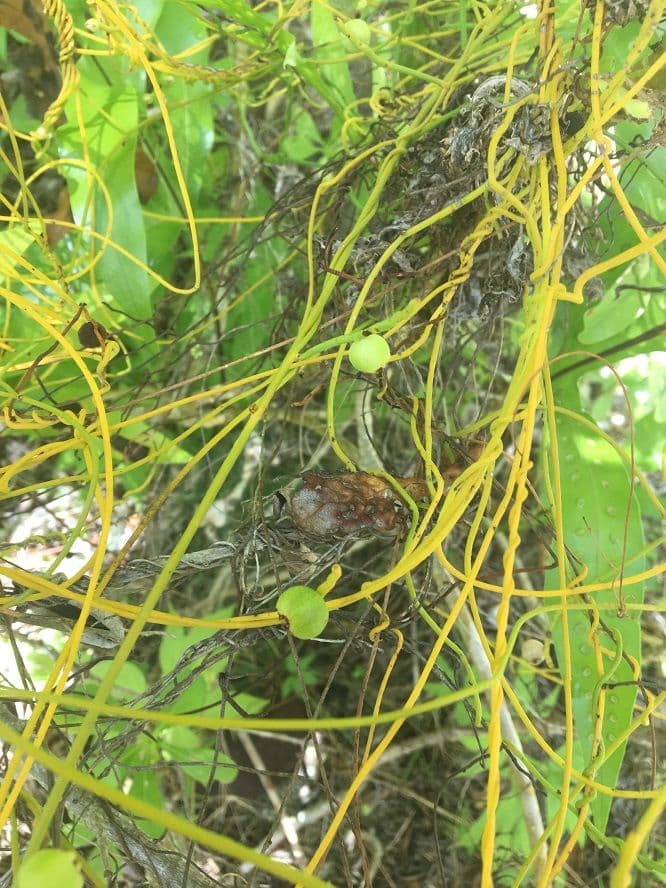
Taino‘a makes some of its own food and takes water and nutrients from other plants. Its fine threads can connect several hosts at once.
- Local names
- Taino’a (Society Islands, Tuamotu Islands), Kainoka (Tuamotu Islands)
- Habitat
- Motu and shore
- Family
- Lauraceae
- Biogeographical status
- Native
- Life form
- Vine
- Abundance
- Common
- Ecosystem
- Mixed forest and beach
About this species
This pantropical vine is a hemiparasite: it photosynthesises using its own chlorophyll while also drawing resources from hosts. Small attachment structures called haustoria penetrate the host’s outer surface and develop into its tissues, taking water and dissolved nutrients.
The fine stems and reduced leaves can appear green to orange according to exposure. Taino‘a attacks many plants, especially woody ones, including native, endemic, and cultivated species. The guide records a single vine using a dozen host species at once. It describes seed dispersal involving birds and strong winds.
The source records traditional purgative uses in the Tuamotu, uses associated with gonorrhoea in the Gambier, combinations with beach-hibiscus roots for haemorrhoids in Tahiti, and applications for jellyfish stings in Fiji. These are distinct regional traditions, not evidence that the preparations treat those conditions.