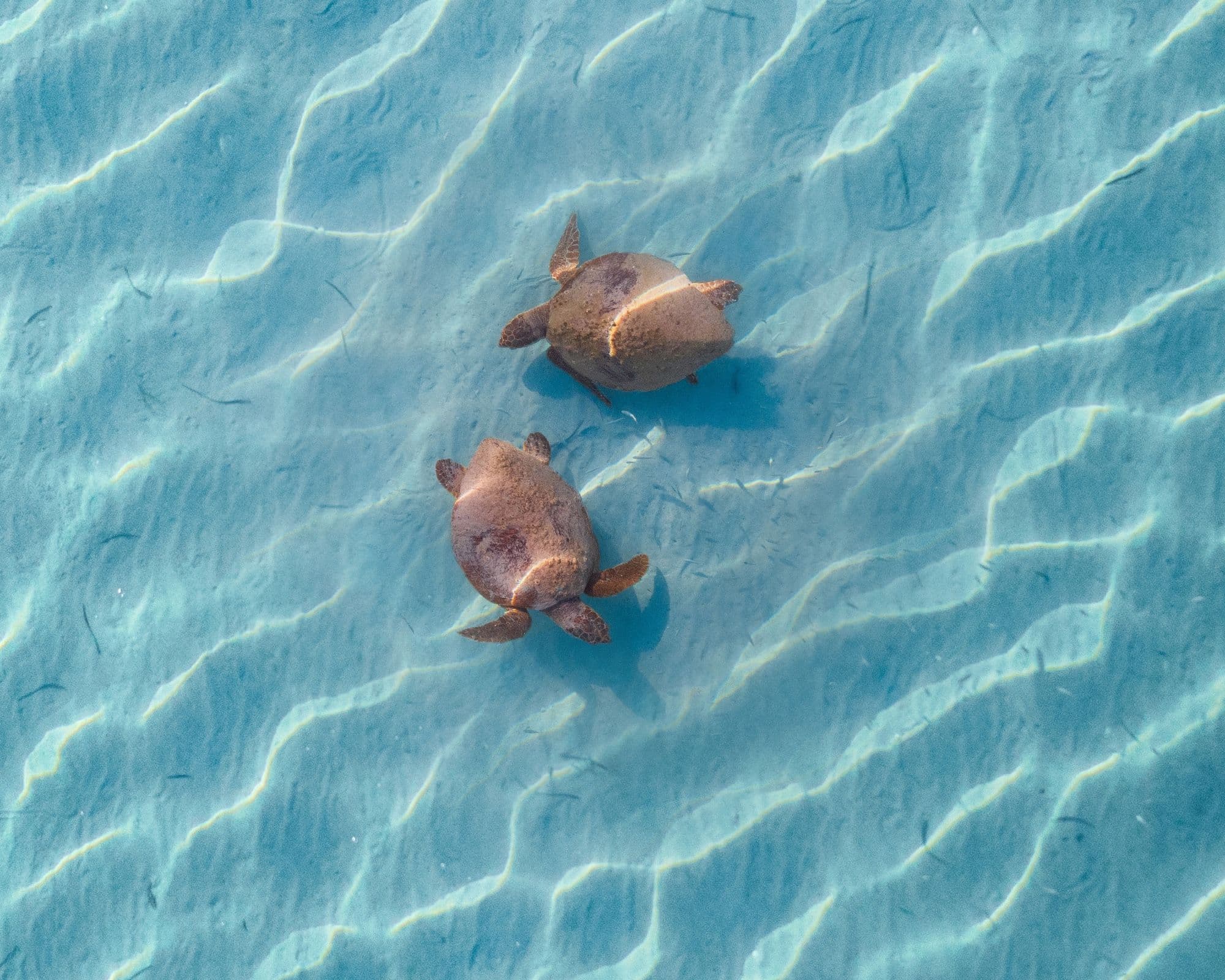
Powerful jaws let the loggerhead break into hard-shelled prey.
- Local names
- Honu taraha
About this species
The loggerhead has a reddish-brown to orange-brown carapace with five pairs of lateral scutes and five vertebral scutes along the midline. These are shell plates, not ribs. Its jaws have no teeth; sharp, horny edges and strong muscles crush crustaceans and molluscs. Fish, jellyfish and sponges also appear in the guide’s account of its carnivorous diet.
Loggerheads range through the Pacific, Indian and Atlantic oceans and the Mediterranean. The guide describes them as rare in French Polynesia. Their nesting range includes temperate regions as well as warmer shores.
Females take decades to mature, commonly around thirty to thirty-five years. The guide describes three to seven nesting visits in a breeding season, with roughly a hundred eggs per nest. Magnetic cues help sea turtles navigate between far-apart feeding and breeding areas.
Hunting for meat and shell was a major concern behind protections introduced during the twentieth century, including measures from the 1970s. The history of protection differs between regions.