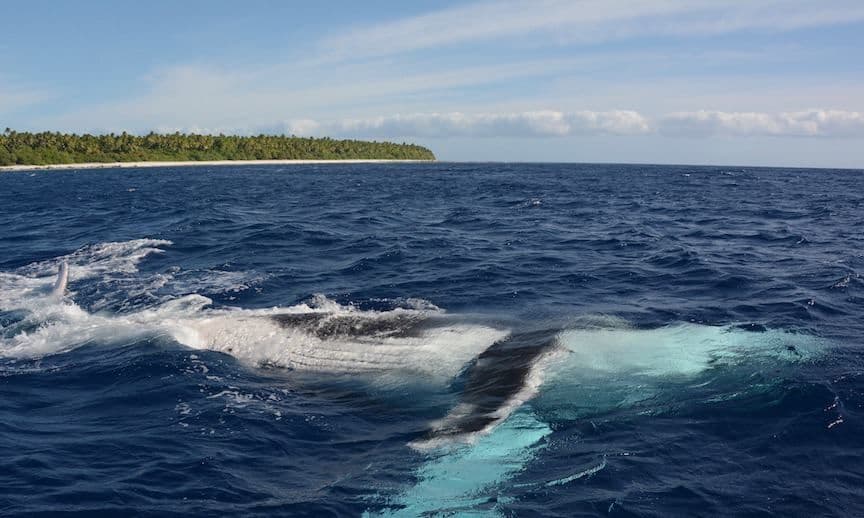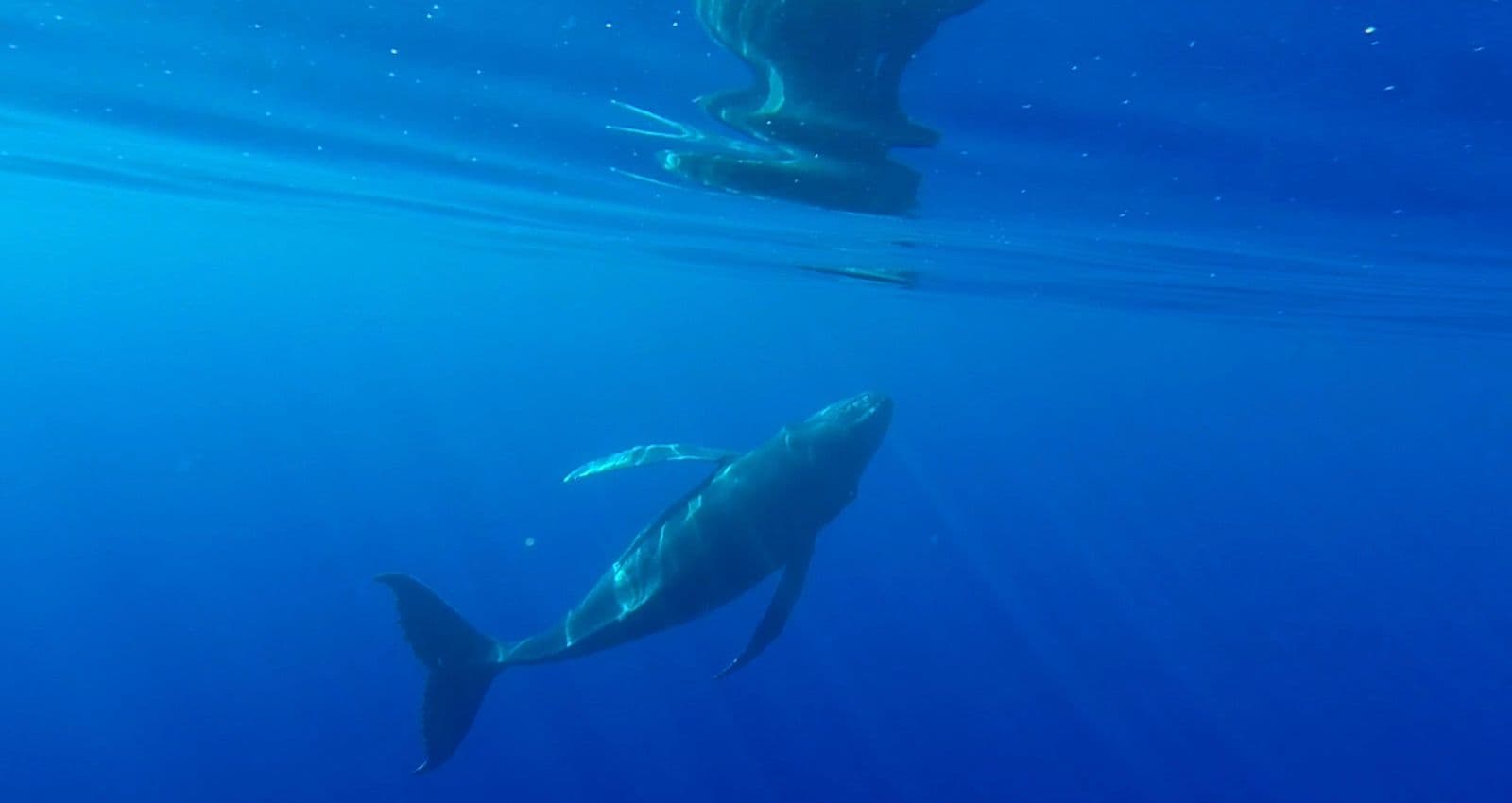
The waters outside Tetiaroa’s reef become part of a much longer journey from Antarctic feeding grounds.
- Local names
- Tohora
- Habitat
- Open ocean
About this species
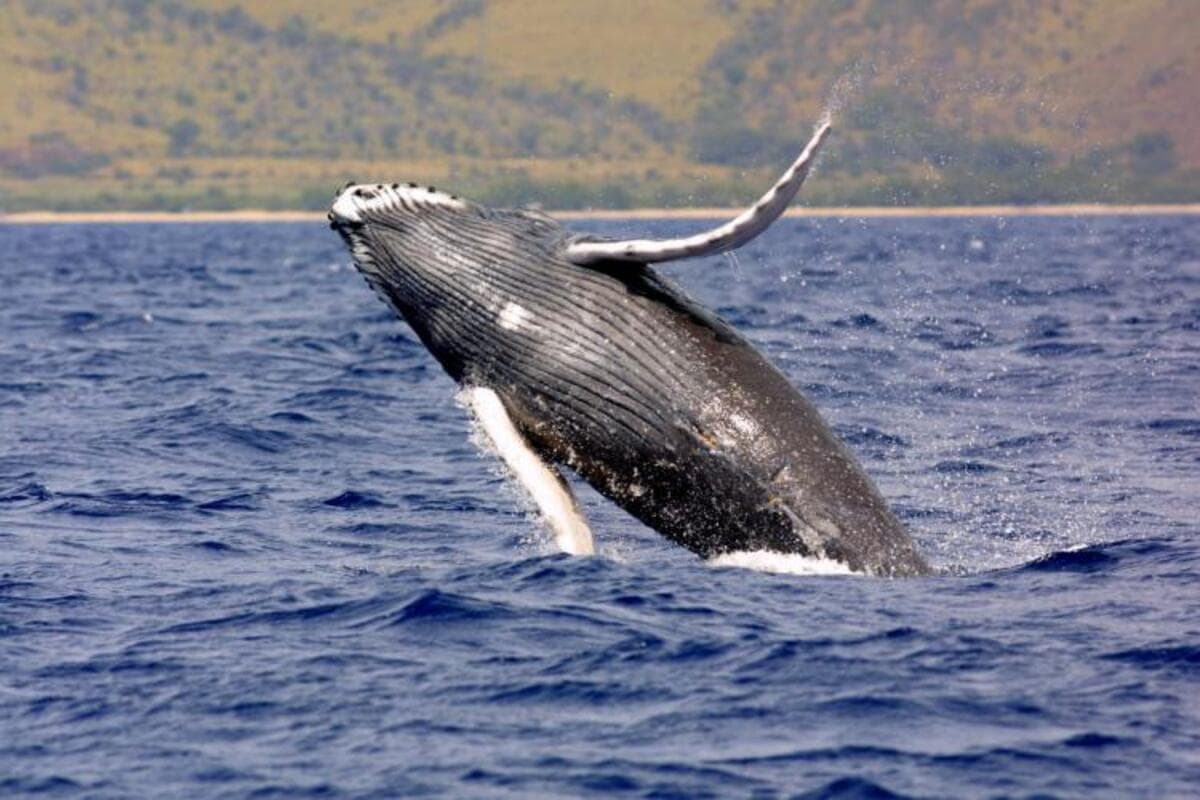
Megaptera novaeangliae refers to large wings and New England, where the species was first described. The “wings” are pectoral fins three to four metres long. The guide gives adult lengths of about 11–14 m and weights of 20–40 tonnes; females are generally around a metre longer than males.
Southern humpbacks spend the austral summer feeding around Antarctica, building reserves for migration and breeding. Krill—small cold-water crustaceans roughly 2–4 cm long and around 2 g in the guide’s description—are an important food. Adults feed intensively for about four or five months, then rely largely on stored energy during the rest of the annual cycle. Nursing calves continue to receive food as milk.
From June to November, humpbacks visit French Polynesia to mate, give birth, nurse and rest. They occur around reefs, passes, bays and lagoons in the Society, Austral, Gambier and Tuamotu islands, with some records from the Marquesas. At Tetiaroa, observations are outside and around the reef.
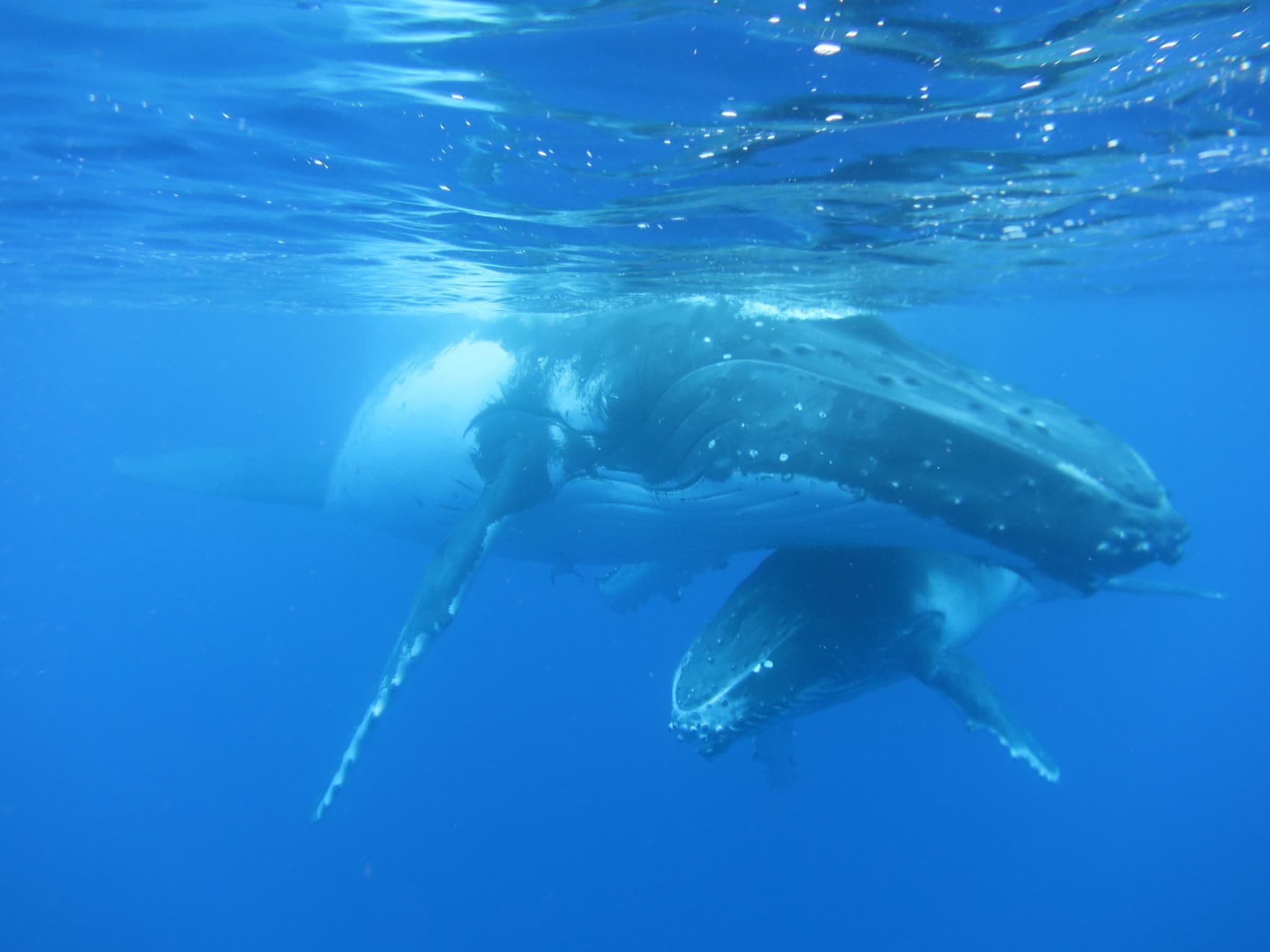
Gestation lasts about a year. A calf nurses for roughly six to twelve months, and females generally give birth every two or three years. Apart from mothers with calves, many associations are temporary rather than permanent pods.
Humpbacks can lift much of their enormous body clear of the sea. Breaches, tail slaps and pectoral-fin strikes are conspicuous on breeding grounds; contests between males can include physical contact.
Males also sing structured, changing songs. Males within a breeding population tend to share a song, but songs are learned and can pass between populations: research has traced themes from French Polynesia to Ecuador. The process of learning and adopting new patterns remains an active area of study, rather than a fixed anthem belonging to a genetically isolated group.
Industrial whaling devastated Southern Hemisphere humpbacks during the twentieth century. The old guide particularly describes the 1920–1966 period and near-total losses in parts of the South Pacific. Its references to endangered populations in Oceania and the Arabian Sea describe population-specific assessments, not a single status for every humpback whale.
French Polynesia’s waters provide important breeding habitat. Around Tetiaroa, a whale may be resting, seeking a mate or accompanying a calf; the reef belongs to a much larger seasonal route.